Why agency recruitment requires a CRM first
Recruitment agency leaders often struggle to evaluate software because vendor marketing blurs the line between a CRM and an ATS. Sales demos treat applicant tracking features and client relationship tools as interchangeable, leaving directors unsure whether they need two systems or one.
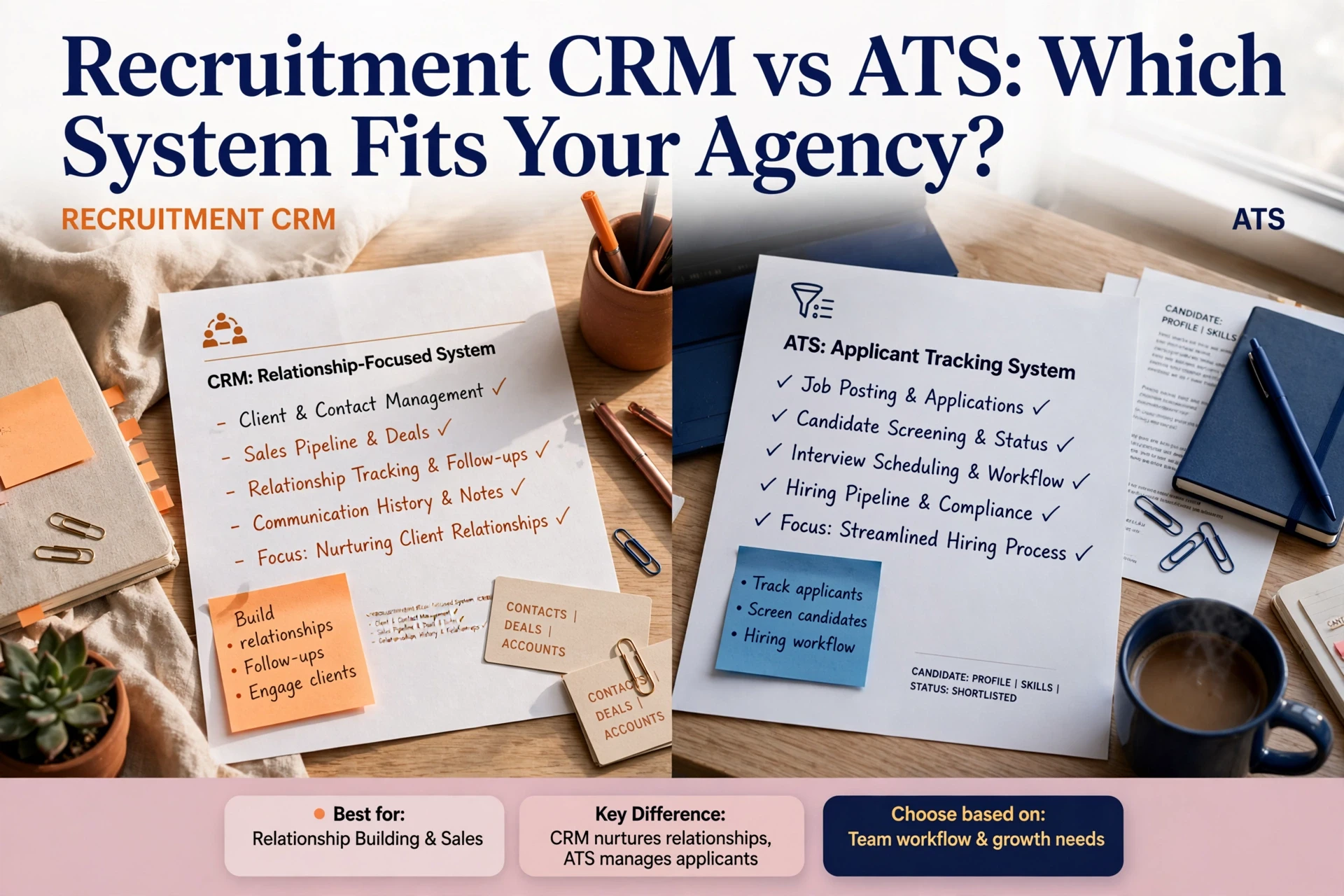
For an agency, the distinction comes down to workflow structure. An applicant tracking system (ATS) originates in corporate HR, where the primary job is managing inbound applications for internal open headcount. A recruitment CRM is built for commercial recruitment agencies, uniting client business development, long-term candidate relationships and live vacancy pipelines in a single system of record.
Corporate HR teams use an ATS to process candidates through defined recruitment stages. Once a role closes, candidate interaction usually stops until the next application arrives.
Recruitment agencies operate under a different commercial model. Consultants must generate new business, maintain contact with candidate networks over years, and re-engage past placements when new roles land. An ATS tracks a vacancy process. A recruitment CRM protects the long-term asset value of your candidate database and client histories.
When an agency relies solely on an applicant tracker, candidate details get buried as soon as a job closes. Consultants lose sight of silver-medallist candidates, client contact records fade, and business development devolves into disconnected inbox notes.
Where applicant tracking fits within agency operations
Agency desks still need structured applicant tracking. Moving candidates from screening to client submission, interview, offer and placement requires clear pipeline controls and audit trails.
In an agency environment, applicant tracking is a feature set within the CRM, not a standalone platform. The candidate record flows into the live vacancy stage without losing historical context.
When recruitment agencies buy separate software tools for applicant tracking and client CRM, three problems emerge:
- Data drifts across disconnected databases, forcing consultants to enter records twice.
- Client context is lost when candidates transition from sourcing pools into active jobs.
- Reporting breaks down because pipeline data lives in one system while fee forecasts live in another.

Matching system capability to your agency revenue model
The weight you place on applicant tracking versus relationship management depends on how your desks generate revenue.
Relationship-led and search desks Agencies running permanent search, niche specialist desks or executive recruitment rely on database depth. Success depends on knowing who is in the market before a vacancy opens. These desks need strong CRM capabilities: detailed client histories, contact tracking, business development pipelines and searchable candidate pools.

High-volume and temp desks Agencies managing high-volume contingent recruitment or temporary staffing face a high throughput of inbound applications. Speed of submission and compliance tracking take priority. Here, workflow structure within the CRM must support rapid screening, automated status updates and candidate management across high job counts.
Most UK agencies run a mix of both models. Choosing software that handles candidate sourcing alongside vacancy progression keeps operational data in one location. Our team helps agency owners evaluate tech stack requirements through dedicated RecTech consultancy engagements.
Testing workflows and candidate data controls
Evaluating software based on vendor feature matrices rarely reveals how a system performs on a live desk. Testing requires loading actual operational scenarios into a trial environment.

Run a trial with two active desks using genuine workflows rather than vendor slide decks:
- Have a consultant log a client cold call, record follow-up tasks and map candidate contacts.
- Track a live vacancy from client intake through candidate submission and interview scheduling.
- Export candidate data to verify that records can be extracted cleanly without vendor lock-in.
Candidate data management also carries strict regulatory responsibilities under UK GDPR. The Information Commissioner's Office (ICO) mandates that agencies remain responsible as data controllers for candidate information.
Before selecting a platform, confirm contract terms regarding data ownership, export permissions and candidate consent tools. If a vendor includes AI screening or candidate scoring features, inspect how automated decisions are made and ensure clear record governance exists.
Practical criteria for agency system selection
When reviewing recruitment software platforms, focus on operational fit rather than software labels:
- Single system of record: Prioritise platforms that combine applicant tracking stages with client CRM capabilities in one database.
- Data accessibility: Ensure candidate records, notes and placement histories can be exported easily without extra fees.
- Workflow speed: Choose interfaces that allow consultants to log calls, update candidate statuses and attach CVs in minimal clicks.
- Implementation scope: Plan time for database cleansing and record deduplication before migrating to a new platform.
Agencies that select software based on daily consultant workflows avoid expensive mid-contract migrations and maintain higher database adoption across their teams. Reviewing system architecture against current desk practices on our services page helps identify stack bottlenecks before signing vendor contracts.