A CRM vendor implementation team will configure your system and move your database across. What they will not do is decide how your desks should operate, resolve years of inconsistent record coding or get reluctant consultants to log their activity. That gap is where most recruitment CRM projects fail. The software goes live on schedule, but the agency ends up with an empty pipeline and broken search workflows.
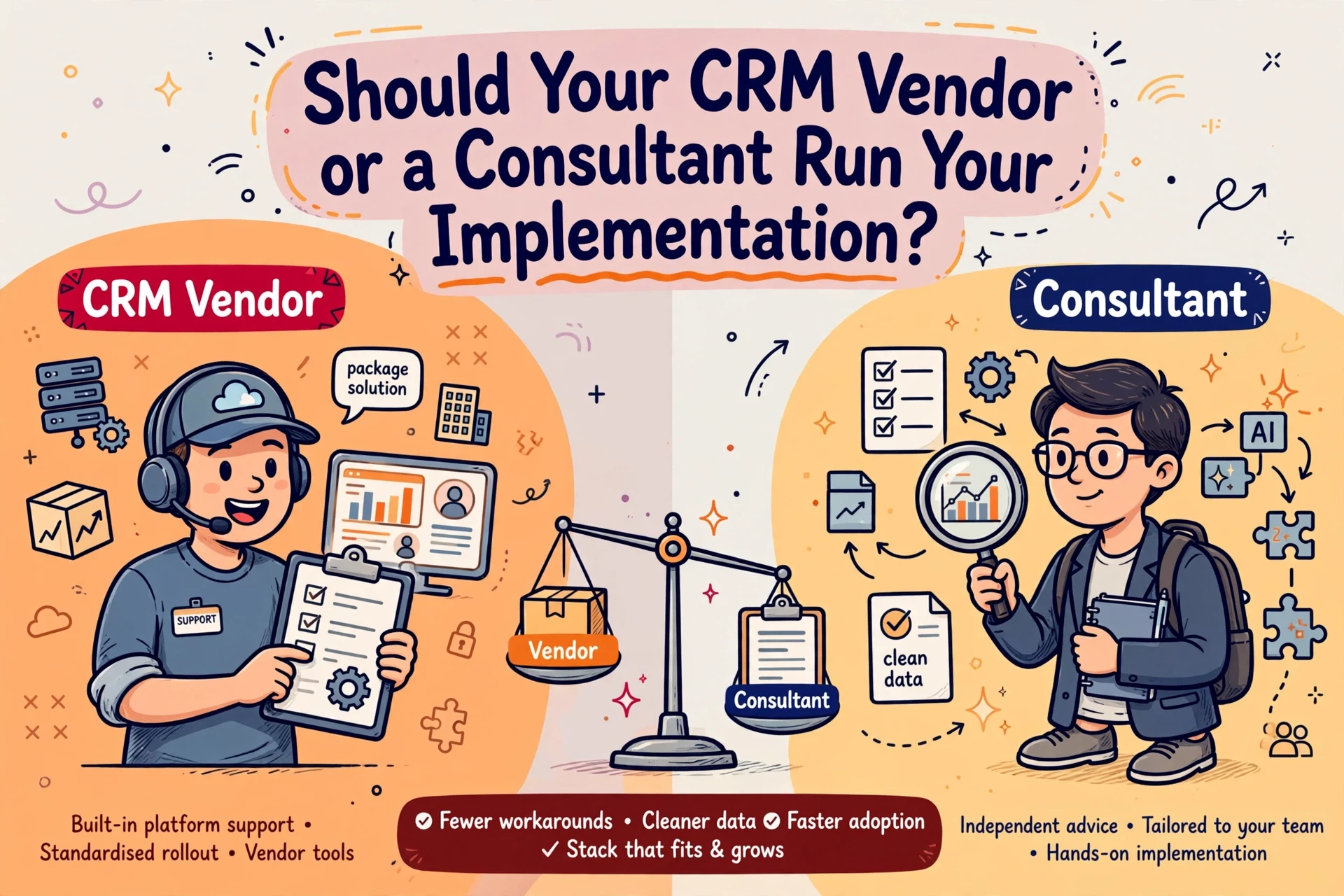
Choosing between a vendor implementation team and an independent recruitment CRM consultant depends on who owns project decisions. The vendor knows their platform product thoroughly, but your team must define field mappings, workflow rules and operational processes. Establishing who holds accountability for each phase before signing a contract prevents budget overruns and delayed go-live dates.
What a vendor implementation team does well, and where its remit stops
A CRM vendor implementation team focuses entirely on platform delivery. They build custom fields, configure user security roles and transfer database tables according to agreed technical specifications. Expect competent execution within the defined product boundaries, but do not expect operational advice.
The four phases of a vendor setup
Most software implementations follow a standardised sequence managed by the vendor:
- Setup and configuration. The vendor builds custom fields, permissions and stage triggers based on the initial requirements document.
- Data migration. Technical scripts extract records from your legacy database and import them into standard destination tables.
- Testing and validation. Your internal team reviews sample records to confirm field placements match the spec.
- Cutover and stabilisation. System access opens to your desks and short-term technical bugs receive priority fixes.
Executing these technical steps requires product knowledge. However, if your initial brief contains flawed operational assumptions, the vendor will configure those flaws directly into your live system.
Where the vendor's knowledge stops
Vendor teams do not know how your agency generates revenue. They cannot tell whether your contract desk operates differently from perm, why specific candidate tags exist or which client contact records are active.
When operational decisions are left unmade, vendor consultants default to standard platform templates. Your billers then spend months creating manual workarounds for processes that should have been configured around their daily habits. Working with a specialist CRM implementation consultancy bridges this divide by converting business operations into exact technical build specifications.
The handover point agencies miss
A sharp boundary exists between business decisions and software construction. Your agency must own data standards, pipeline definitions and user adoption expectations. The vendor owns technical assembly. When agencies expect the vendor to guide business strategy, core workflow decisions get missed.
What goes wrong when nobody owns the project
Implementation failures in recruitment agencies rarely stem from broken code. They stem from unassigned ownership. When neither the vendor nor an internal leader takes responsibility for operational readiness, four distinct breakdown points emerge.
Data mapping without sign-off
Vendors transfer the raw data provided to them. If your legacy system contains duplicated records, conflicting job titles and incomplete contact fields, those issues transfer directly into the new environment.
Before migrating records, your team must audit field structures and define clear standardisation rules. A structured data intelligence analysis evaluates database quality, flags duplicate records and highlights incomplete fields before data moves. Without senior sign-off on field mappings, consultants lose confidence in search results on day one.
Workflow decisions deferred until build
Vendor engineers construct system logic based on existing habits unless instructed otherwise. Questioning whether permanent and contract desks should share job pipelines or how candidate submission steps work requires operational authority. Deferring workflow decisions until after go-live forces expensive system reconfigurations later.
Validation without dedicated time
Validating data structure and testing candidate placement workflows requires focused effort. If this responsibility falls on busy billers without allocated time, validation gets rushed. Data errors then surface after cutover when consultants are handling live client requirements.
Adoption without operational planning
Software functionality does not guarantee user adoption. If consultants find data entry cumbersome or see no clear benefit to their desk management, they revert to personal spreadsheets. Successful adoption requires designing daily desk routines alongside software configuration, as explored in our session on documenting recruitment processes before tech implementation.
What an independent consultant adds to the build
An independent recruitment CRM consultant does not replace the vendor project team. Instead, the consultant acts as project manager and operational strategist, taking accountability for agency-side deliverables that software vendors do not cover.
Project ownership versus technical configuration
While the vendor handles technical build and database loading, an independent consultant manages end-to-end project execution. This includes leading workflow design, establishing field mapping rules, directing validation testing and keeping both parties to agreed schedules.
Acting as the agency's technical advocate
Vendor project managers report to software management. An independent consultant acts exclusively in your interests. They evaluate vendor technical claims, prevent scope creep and identify implementation risks before deadlines slip. Drawing on cross-platform experience across dozens of implementations, an independent advocate prevents common migration pitfalls.
When an outside consultant is unnecessary
Hiring external implementation support is unnecessary for every agency. If your business has an experienced operations director with spare capacity, clean data and standard desk workflows, internal management alongside the vendor team is sufficient.
Note that project implementation consultants typically conclude their engagement at system cutover. End-user desk training and ongoing helpdesk support require internal planning regardless of whether external implementation advice is used.
Five questions to test project ownership
Before signing a recruitment CRM contract, evaluate project readiness by assigning named individuals to these five key responsibilities:
- Who holds single-point accountability for overall project delivery across both vendor and agency teams?
- Who decides which legacy database fields are migrated and which are retired?
- Who defines updated workflow rules for perm, contract and temp desks before configuration starts?
- Who reviews sample data migrations to confirm record accuracy before go-live?
- Who structures daily consultant routines to ensure full platform adoption post-launch?
Evaluating your score
Count how many of those questions have a specific named internal leader assigned. If four or five questions have clear internal ownership, your agency can likely manage implementation directly with the vendor team.
If three or more questions yield vague responses or rely on vendor assumptions, external project management is necessary. Unassigned operational responsibilities inevitably lead to project delays and poor consultant engagement.
Questions to ask vendor and consultant before signing
Asking precise technical and operational questions before contract execution clarifies expectations across all parties.
Direct questions for the vendor
- Which specific workflow modifications fall outside standard configuration fees?
- What precise deliverables are included in your standard go-live package?
- How many hours per week will your project manager require from our senior leadership team?
- What exact data formatting requirements must we meet before database extraction begins?
- How are scope change requests priced and managed during active build phases?
Questions for an independent consultant
- What specific tasks do you manage directly versus tasks delegated to vendor engineers?
- How do you structure data validation checks before final cutover?
- Will you participate directly in technical build reviews with the vendor team?
- What handoff documentation and desk guidelines do you deliver at go-live?
- What baseline timeline do you project for an agency of our size and complexity?
Verifying reference accounts
Ask both the vendor and independent consultant for reference contacts at agencies with similar desk structures. When speaking with reference clients, focus on operational realities: ask what project elements delayed cutover, how data discrepancies were handled and what percentage of billers actively log data daily.
Managing a realistic implementation timeline
For recruitment agencies operating between five and 80 billing consultants, a standard CRM migration requires 12 to 14 weeks from project initiation to full cutover.
Implementation phases and schedules
- Weeks 1 to 2 (Discovery): Define operational scope, map desk workflows and assign project roles.
- Weeks 3 to 4 (Data mapping): Audit existing database fields, establish standardisation rules and map legacy records.
- Weeks 5 to 8 (Build and test migration): Vendor configures platform settings while technical scripts complete test record imports.
- Weeks 9 to 10 (Validation): Internal teams test sample records, refine search structures and correct mapping anomalies.
- Weeks 11 to 12 (Go-live cutover): Final data extraction takes place, system access opens and desks transition to the new CRM.
Timeline extensions occur primarily when source database records require substantial remediation, when workflow sign-offs stall internally or when project phases collide with peak trading cycles.
Post-launch stabilisation
Go-live marks the transition to active desk usage rather than project completion. Plan for a two-week to four-week stabilisation window immediately following launch. During this period, minor layout adjustments, report refinements and user permission tweaks will emerge. Ensuring dedicated oversight during stabilisation secures desk confidence while billing routines adapt.
Deciding your implementation strategy
Determining who leads your implementation requires an honest assessment of internal capacity and database readiness. Vendor implementation teams excel at technical delivery, but they rely entirely on your agency to provide clear operational direction and structured data.
If your data structures are established, your processes documented and a dedicated internal lead can commit substantial weekly hours, direct management with the vendor yields a successful rollout. If your database requires structural review, your workflows need updating or operational leadership is at capacity, engaging an independent project consultant protects your capital investment. Reviewing our recruitment technology articles offers further frameworks for evaluating agency rec-tech decisions.
Frequently asked questions
Should a recruitment CRM vendor or an independent consultant run our implementation?
A vendor implementation team should handle platform build and database loading. If your agency lacks a dedicated internal lead, has complex desk workflows or holds inconsistent database records, an independent consultant should manage project strategy, data mapping and operational validation.
How long does a recruitment agency CRM implementation take?
A typical recruitment CRM implementation takes 12 to 14 weeks for agencies with five to 80 consultants. Poor source data quality, delayed workflow approvals and seasonal trading peaks represent the main causes of timeline extensions.
Who owns data migration during a recruitment CRM switch?
Your agency owns data migration strategy and validation. The CRM vendor executes the technical data extraction and import scripts, while an independent consultant or internal project lead defines field mapping rules, data scope and sign-off criteria.
What data preparation is required before migrating to a new recruitment CRM?
Before migrating, agencies must audit database fields, define standard coding formats for job titles and industries, flag duplicate candidate and client records and decide which historical fields should be retired rather than transferred.