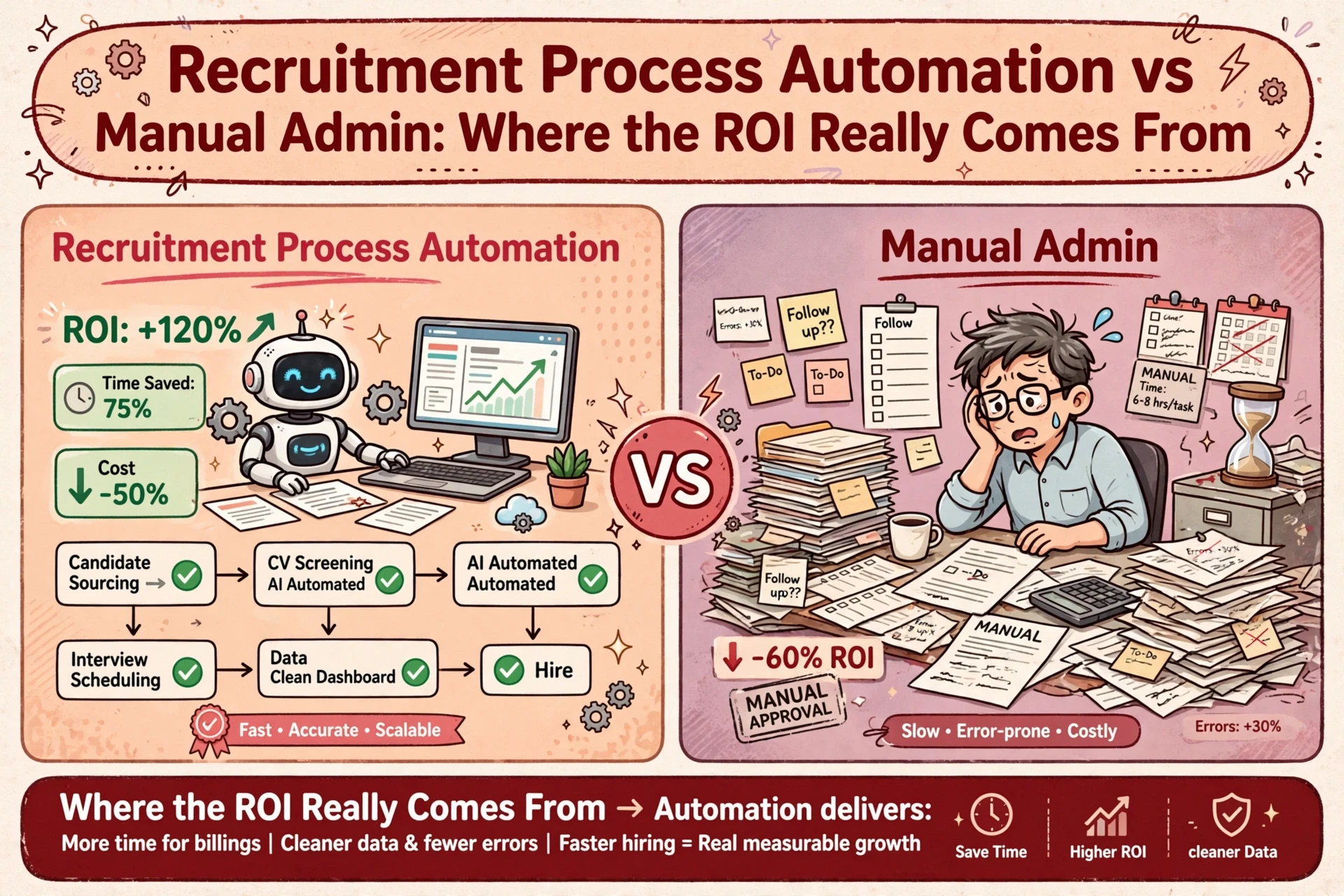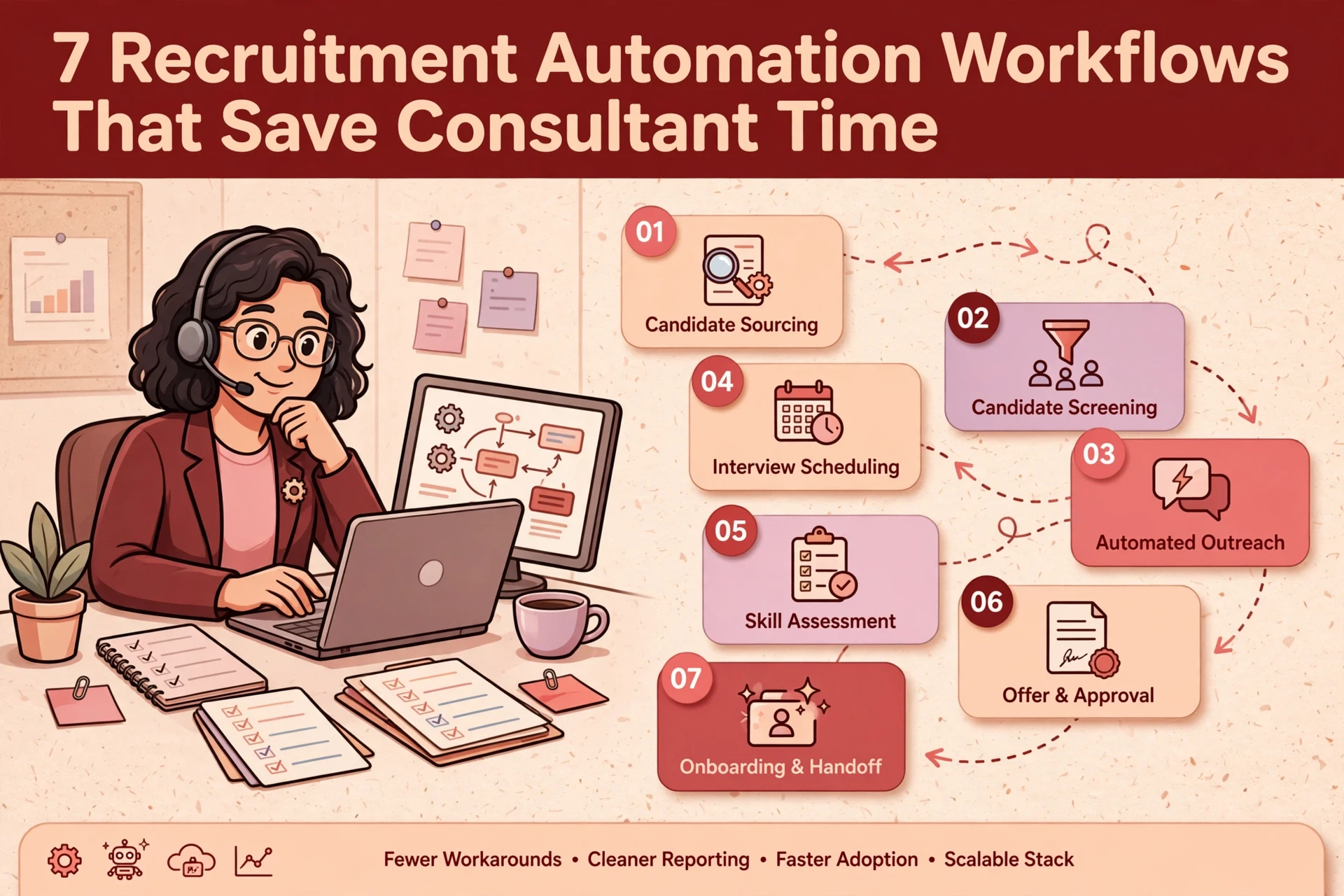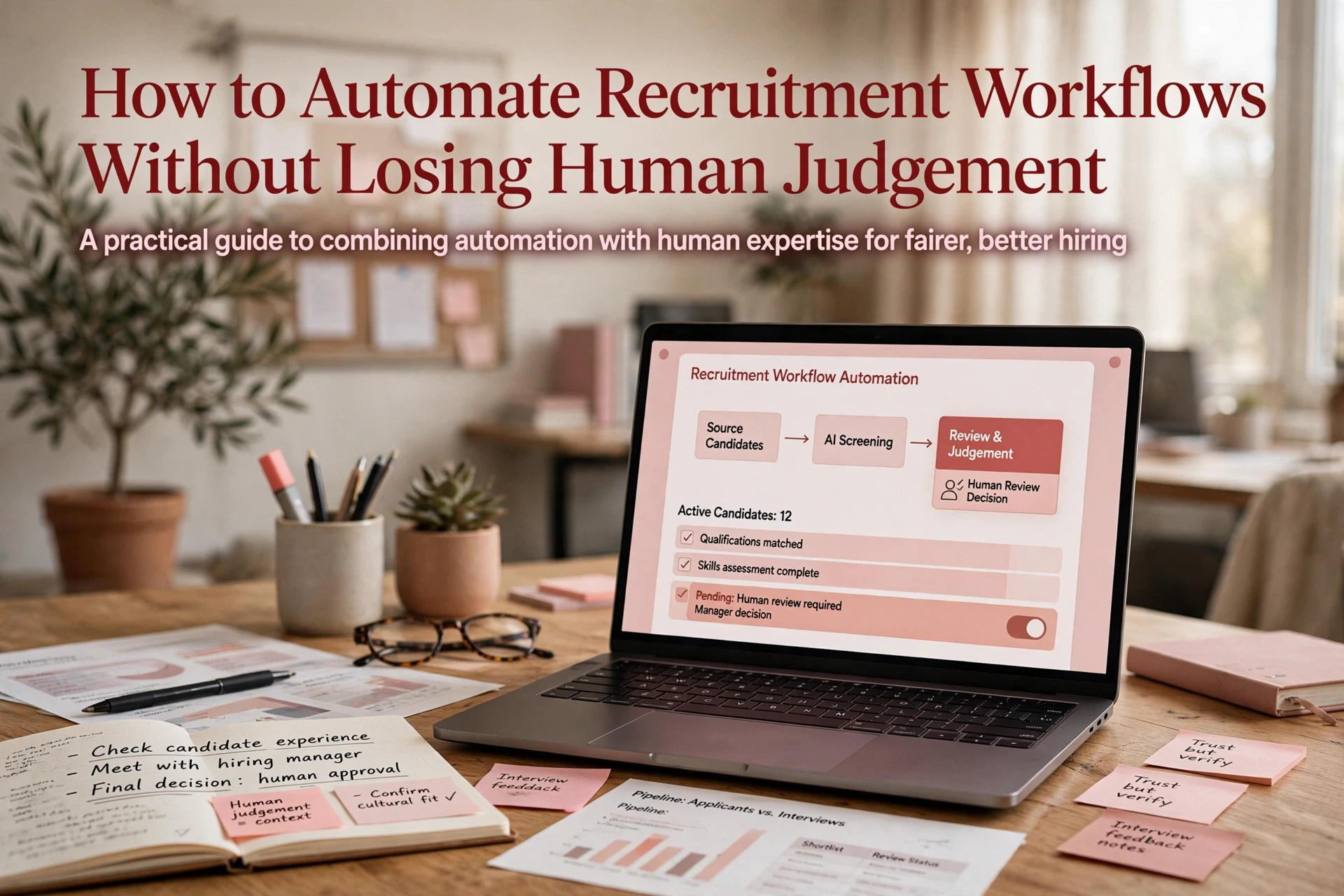
Comparing recruitment process automation against manual hiring framing one as superior misses the operational reality. Reliability in a recruitment agency is not about processing CVs faster. It is about whether every candidate is evaluated against consistent criteria, every client update is logged in your CRM, and every placement decision can be defended.
Automation excels at high-volume administrative tasks where rules are fixed. Manual hiring remains far more reliable where context, career motivations, and candidate relationships determine the outcome. Building a dependable agency operation requires knowing where to hand tasks to software and where to keep consultants in control.
Speed versus structure in candidate evaluation
Fast candidate processing that misses the brief is simply rapid failure. Speed only adds value when the underlying assessment process is consistent.
A reliable recruitment operation produces comparable candidate shortlists regardless of which consultant manages the assignment. When two consultants work identical roles, variations in candidate quality usually stem from unstructured screening methods rather than candidate supply. Research on structured selection methods demonstrates that standardized scoring rubrics predict candidate performance far more accurately than recruiter gut feel.
Reliable recruitment depends on five core operational controls:
- Standardised success criteria agreed with the client before candidate sourcing begins.
- Structured screening questions applied consistently to every candidate.
- Centralised candidate and client records maintained inside the CRM.
- Clear ownership for each stage of the placement workflow.
- Consistent feedback logging to review placement performance over time.
Automating an unstructured process simply accelerates administrative errors. Establishing clean workflow stages must come before introducing automated rules.
Where automation beats manual processing
Software outperforms humans on high-volume repetition. When a workflow task requires strict adherence to defined rules, automated processes eliminate human fatigue and oversight.
Administrative tasks and compliance checks
Chasing feedback, sending interview confirmations, logging call notes, and collecting compliance documentation consume significant consultant time. Consultants under pressure often skip administrative steps. Automated workflows perform these tasks consistently.
For example, public sector recruitment teams across North Central London automated routine onboarding administration. The project reduced processing time from conditional offer to completed compliance checks from 30 days down to 14 days. Data completion on starter documentation rose from 70% to over 99%, demonstrating how automated tracking outperforms manual data entry.
Structured screening and CRM routing
Filtering applicants by location, qualification, salary expectation, and right-to-work status follows clear logic. Automated rules evaluate every applicant against the same criteria, ensuring suitable candidates are not overlooked during busy periods. Automated routing assigns candidate records to the correct desk consultant and flags missing compliance files before placement.
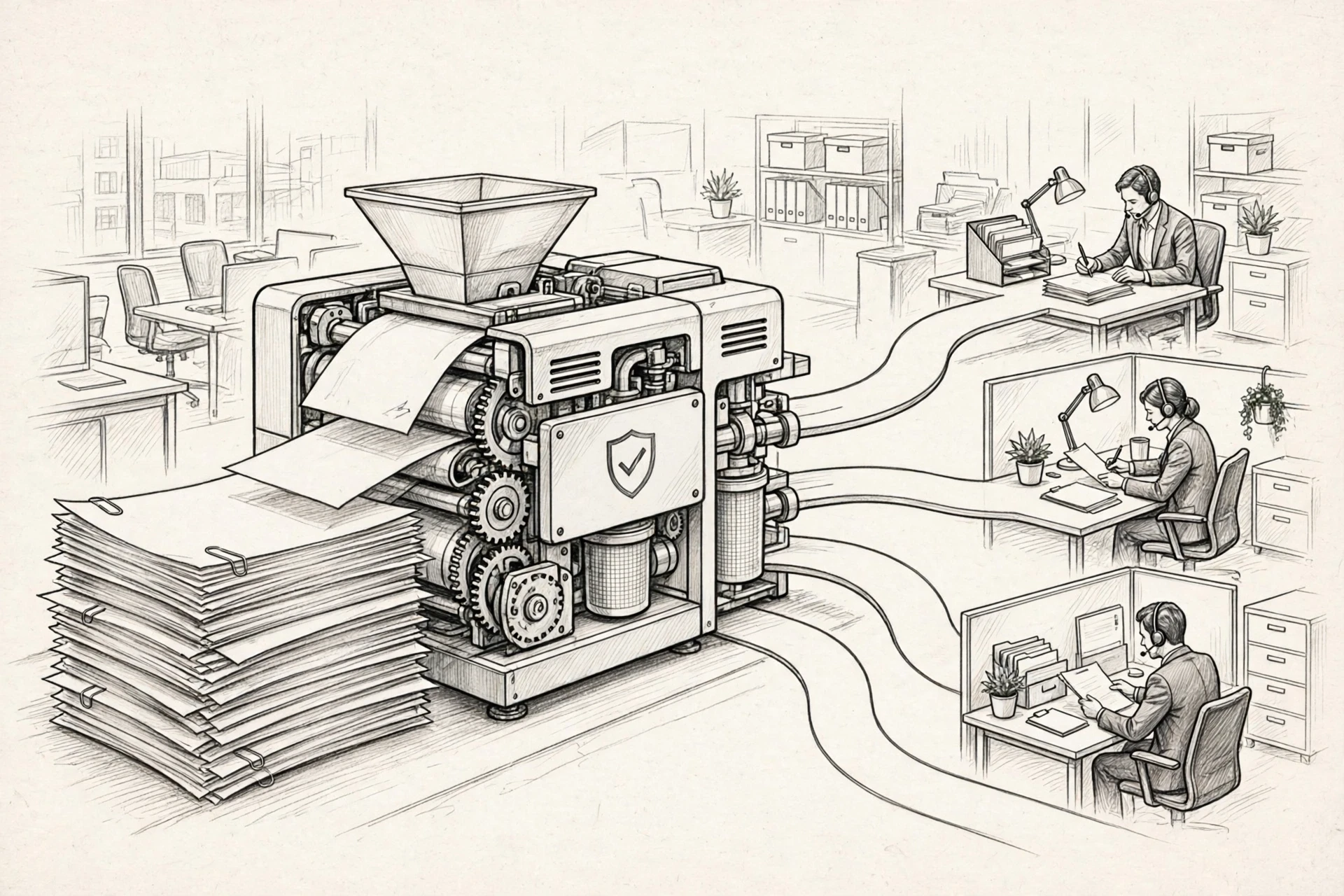
These automated rules remain reliable only as long as the underlying data inputs are accurately structured inside your database. Agencies seeking to refine candidate data rules can review our RecTech consultancy services for infrastructure guidance.
Where recruiter judgement remains essential
While automation handles routine data movement, it fails when evaluating nuanced human information.
Evaluating career context and transferable skills
Keyword parsing evaluates exact text matches. It fails to interpret why a candidate wants to change sectors or how skills transfer between industries. A candidate with an unconventional work history might be ideal for a niche perm role, but keyword filters often reject the CV format automatically.
Experienced recruiters identify transferable capabilities, explain career gaps, and evaluate candidate potential. Research into automated screening systems confirms that algorithms frequently extract candidate skills inconsistently, missing contextual nuance that a trained consultant spots immediately.
Managing candidate and client relationships
Client and candidate trust cannot be automated. Candidates share genuine salary expectations, counter-offer risks, and career concerns only with consultants who demonstrate active listening. Clients share internal office dynamics and informal requirements that never appear on a formal job spec.
Automated communication can alienate high-calibre candidates if overused during selection. For recruitment agencies competing on candidate quality, personal trust forms the foundation of commercial relationships.
Compliance, bias and candidate rights
Neither manual hiring nor automated screening is inherently immune to error. Understanding the operational risks of both helps agencies build appropriate oversight.
Automated tools replicate existing bias
Automated screening models train on historical recruitment data. If past placement data reflects biased hiring decisions, automated systems replicate those patterns at scale. Guidance from the Information Commissioner's Office (ICO) highlights that automated systems can disadvantage specific candidate groups without objective justification unless actively monitored.
Consistency in automated processing is not equivalent to fairness. An unchecked screening rule applies unfair criteria uniformly across thousands of records.
Transparency and human oversight under UK GDPR
Manual screening carries risks of individual bias, fatigue, and undocumented decision-making. However, human recruiters can explain the reasoning behind a hiring decision.

Under UK GDPR provisions covering automated decision-making, candidates retain the right to understand how automated selection tools evaluate their data and can request human intervention. Agencies using automated screening must maintain human review steps for final shortlist selection and candidate rejection.
A simple framework to audit your tasks
Agencies deciding which workflow steps to automate should evaluate each operational task against three criteria:
- Is the task strictly rule-based, following identical steps every time?
- Does a operational error cause minor rework rather than legal or commercial breach?
- Would a consultant notice within minutes if the automation failed?
If a task meets all three conditions, it is a suitable candidate for automation. Examples include interview scheduling reminders, status update notifications, and initial document requests.
Tasks involving final shortlist selection, offer negotiations, right-to-work validation, and candidate rejections must retain direct human oversight. Explore our broader recruitment technology articles for further analysis on workflow design.
Implementing a reliable hybrid workflow
The most practical approach for recruitment agencies combines administrative automation with human oversight. Software manages database entry, scheduling, and routine chasing. Consultants manage relationship building, candidate evaluation, and placement decisions.
Introduce automation incrementally rather than re-engineering your entire tech stack at once. Select one repetitive administrative pain point, implement automated rules within your CRM, and review output quality weekly. Adjust rule logic based on real candidate responses before expanding automation to other desks.
Evaluating tech stack performance requires looking beyond vendor promises. You can inspect our wider technology consulting services to understand how system architecture supports agency workflow.
Setting your next operational priorities
Review your current recruitment workflows to identify administrative bottlenecks that draw consultants away from billable work. Map out manual data entry tasks, measure how often steps are missed, and establish clear boundaries between automated tasks and recruiter judgements. Reliability comes from consistent governance across both software and staff.
Frequently asked questions
Is recruitment automation more reliable than manual hiring?
Neither is more reliable across the board. Automation is more dependable for high-volume, rule-based tasks such as chasing feedback, confirming interviews and routing records, because it does not tire or skip steps. Consultants are more dependable where context decides, such as career motivation, transferable skills and client relationships. Reliable agencies use each where it is strongest.
How can automation reduce admin time and manual data entry in a recruitment agency?
Automate the repetitive steps consultants skip when they are busy: logging call notes, sending interview confirmations, chasing feedback, collecting compliance documents and routing records to the right desk. Software performs these the same way every time, so the CRM is completed more consistently. Clean up your workflow stages first, because automating an unstructured process only speeds up the errors.