A consultant picks up a contact record to make a business development pitch, only to find the hiring manager left three years ago. Multiply that across thousands of client contacts, and your CRM becomes a repository of old entries rather than an active sales pipeline.
Data intelligence fixes this by scoring each contact record, identifying missing fields and enriching the details worth keeping. Instead of relying on guesswork, your desks work from target lists built on verified client fit and current record quality.
This guide sets out how UK recruitment agencies with five to 80 consultants use data intelligence to prioritise outreach, improve CRM usability and prepare contact data for automation.
What data intelligence means for recruitment agencies
Data intelligence in recruitment is the systematic scoring, completion and coding of contact records in your CRM. It measures how complete each client contact record is against the specific fields your desk relies on, while scoring the record against a profile of clients your agency has actually converted.
This work focuses strictly on contact records: the hiring managers, department heads and business leaders your agency targets for business development. Candidate records are not included in this analysis.
Data intelligence versus traditional reporting
Traditional CRM reporting looks backwards. It counts calls logged, CVs sent and fees billed to tell you what happened last month. Data intelligence looks forwards. It scores live contact records for client fit and completeness, showing consultants where the next fee is most likely to come from.

Why the record is the unit of work
Dashboards show aggregate trends, but consultants win business one contact at a time. The commercial value sits inside individual records: direct email addresses, current job titles, accurate job functions and past company engagement.
Scoring contact records gives consultants a direct confidence signal on every account. One-off analysis projects allow agencies to fix record quality without disrupting daily desk activity, ensuring consultants keep billing while the underlying data improves.
How recruitment agencies apply data intelligence
UK recruitment agencies use data intelligence across three primary operational areas.

Separating usable contact records from records needing review
Most agency databases hold a mix of usable contacts, incomplete entries and duplicate records. Data intelligence scores each contact record individually. Usable records are approved for active outreach, missing fields are flagged for selective enrichment, and potential duplicates are marked for internal team review. Records are flagged rather than deleted, keeping account control firmly with your consultants.
Ranking contact priority for business development
With contact records scored, consultants rank their daily outreach by objective fit rather than memory. A record showing a verified hiring manager title, matching sector coding and active trading history takes priority over an unverified contact last updated years ago. This structured order of priority increases contact rates because consultants spend less time chasing wrong numbers or departed managers.
Building target lists for new sectors or desks
When launching a desk or entering a new sector, agencies use existing converted records to define an ideal client profile. Data intelligence tests your database against this profile, identifying matching contacts and revealing where data coverage is strong enough to support outreach. For a complete step-by-step framework, read how to build a recruitment data intelligence strategy.
Where the data comes from and how it is scoped
Data intelligence relies primarily on the records your agency already owns, supplemented by targeted external data.
Scoping your existing CRM records
Your client contact records are the baseline. They contain job titles, company domain names, past placement history and consultant notes. When data entry habits vary across desks, missing fields and inconsistent job titles build up over time.
Before introducing new software or AI workflows, agencies must establish the true state of their database. CRM data quality decides what your systems can do, so measure it first rather than trust it.
Enrichment as a separate, one-off project
Enrichment fills specific gaps identified during initial analysis, such as updated job titles, verified company email addresses or industry classifications. Scoped as a separate project following initial analysis, enrichment targets only high-value records matching your target profile.
A realistic data project avoids chasing total data coverage, as public sources never match 100% of records. Where an agency requires ongoing data maintenance after project completion, external partners can support that work while internal desk habits keep data aligned. Agencies seeking structured analysis and targeted enrichment typically engage a dedicated data intelligence service.
Moving from contact scores to reporting and infrastructure
Structuring contact data allows agencies to connect desk activity to strategic forecasting.
Scoring, target lists and data warehouses
Raw CRM entries move into structured commercial assets through three stages:
- Record scoring: Contact records receive numerical scores based on ideal client fit, company headcount and historical conversion.
- Target list generation: Scored records are grouped into operational lists, giving consultants verified targets in specific sectors.
- Data warehousing: Scores, activity logs and job data replicate into a central data warehouse for fast querying.
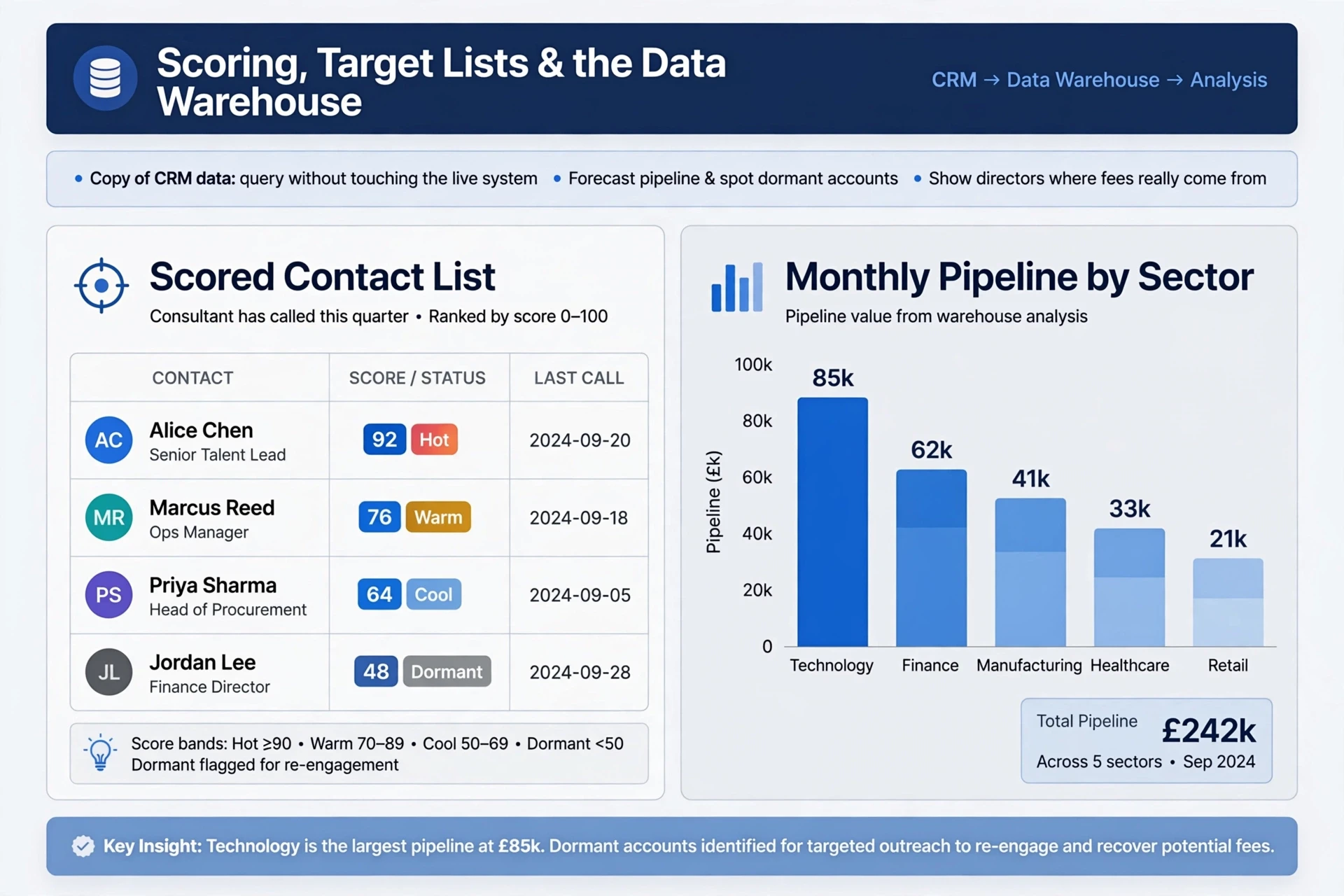
This is the sort of work a data intelligence service covers, from scoring through reporting.
Evaluating data readiness for AI workflows
Before deploying AI search or automated outreach, agencies must audit their underlying contact data across three criteria:
- Field completeness: The percentage of contact records holding required fields such as function and seniority.
- Duplicate volume: Duplicate records that distort reporting metrics or trigger double-contacting.
- Data consistency: Standardised job titles and industry categorisations across all records.
Addressing these criteria first prevents AI tools from expanding existing errors across your database.
What good looks like and where projects stall
Successful data projects produce predictable operational improvements, while misaligned projects suffer common friction points.
Operational benefits of structured contact data
Following a structured data project, consultants start each week with verified contact lists inside the CRM. Pipeline reports reflect valid hiring contacts rather than duplicate entries or obsolete records. Data enrichment spending remains controlled because budget is allocated strictly to high-value targets.
In our experience across more than 300 agency advisory engagements, agencies that define explicit data criteria achieve far higher CRM usage across their desks.
Common sticking points in agency data projects
Agencies frequently encounter four operational hurdles during implementation:
- Vague project objectives: Defining projects as general data improvements rather than tying outcomes to business development targets.
- Excessive project scope: Attempting to analyze and enrich every legacy record at once rather than focusing on target sectors.
- Unclear account ownership: Failing to assign responsibility for record validation, leading to rapid data decay.
- Tool-first purchasing: Buying automation or AI tools before establishing structured contact data.
A focused data intelligence strategy keeps the work bounded and the payback visible.
Common mistakes that waste recruitment budget
Avoiding key operational missteps keeps data intelligence projects cost-effective and compliant.
- Enriching records before scoring fit: Purchasing external contact data for accounts that do not match your ideal client profile wastes budget. Always score existing records first.
- Pursuing total data completion: Demanding 100% field completion across all legacy records drives up costs without yielding proportional fees.
- Deleting or merging suspected duplicates automatically: Automated de-duplication risks overwriting critical client history. Flag duplicate records for manual review by account owners instead.
- Treating data intelligence as an open-ended project: Unbounded data projects lead to ongoing cost leakage. Scoped, one-off projects deliver clearer financial return.
- Ignoring regulatory data standards: Collecting personal contact data without a lawful basis risks legal non-compliance. Agencies should consult guidelines from the Information Commissioner's Office regarding B2B data handling under UK GDPR.
How to start scoring your CRM data
Begin by isolating the contact records driving your primary revenue streams. Audit these records for field completeness, job title consistency and duplicate entries.
Score existing client contacts against your converted accounts before committing budget to enrichment. Flag incomplete entries and suspected duplicates for review rather than deleting records, keeping control with desk consultants. By establishing structured contact records first, your agency builds a CRM that directly supports billings and future automation.
Frequently asked questions
How do recruitment agencies use data intelligence?
Recruitment agencies use data intelligence to score contact records against an ideal client profile, rank daily business development outreach, and generate targeted account lists for new desks. The process focuses on contact records within the CRM to improve business development efficiency and reporting accuracy without purchasing unnecessary external software.
Is recruitment data intelligence GDPR compliant?
Data intelligence is fully compliant with UK GDPR when agencies restrict data collection to professional B2B contact details, maintain legitimate interest assessments, and avoid sourcing unauthorised personal information. Data processes should focus on corporate emails and professional roles, leaving records transparent and easily manageable upon request.
Should an agency enrich CRM records before scoring them?
Agencies should always score existing contact records for account fit before investing in data enrichment. Scoring identifies high-value accounts worth pursuing, preventing wasted expenditure on legacy or non-matching contact records that consultants will not contact.
Should duplicate CRM records be merged or deleted automatically?
Duplicate records should be flagged for review rather than merged or deleted automatically. Automated merging risks overwriting valuable placement history or consultant notes. Assigning flagged records to account owners ensures client history is preserved accurately.