
Recruitment agency leaders who expand headcount or increase software expenditure at the first sign of a market thaw risk carrying idle overhead too early. Equally, directors who wait for nationwide placement growth before preparing their infrastructure will miss the initial wave of client mandates. Interpreting UK hiring signals requires looking past headline indices to desk-level leading indicators.
Recent data from the KPMG and REC Report on Jobs shows permanent placement declines reaching their softest point in nearly three years. While headline numbers remain below the neutral 50.0 threshold, the direction of travel indicates market stabilisation rather than immediate expansion. Agency leaders must separate flatlining demand from genuine growth before adjusting operational capacity.
Differentiating market stabilisation from true growth
The Permanent Placements Index floating near 49.0 indicates that placement volumes are shrinking far more slowly than in previous quarters, not that overall market volume is increasing. A reading below 50.0 still represents contraction.
Three distinct factors drive this index score:
- Permanent placements are stabilising in northern regions while southern markets remain subdued.
- Temp billings show sustained strength as employers opt for flexible capacity over long-term headcount.
- Overall vacancy volumes continue to contract across most commercial sectors, with engineering standing out as a notable exception.
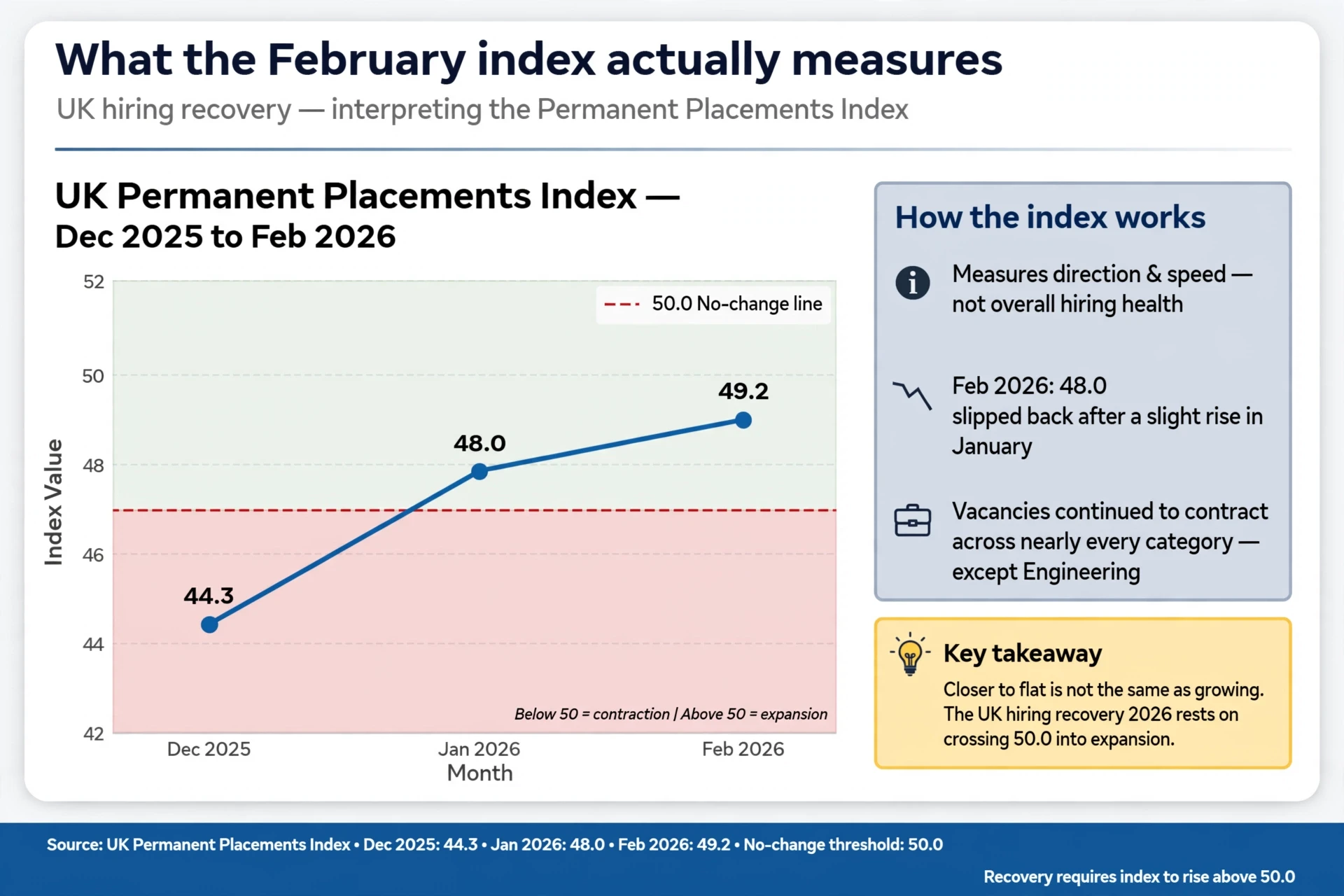
The index measures rate of change rather than total market health. A curve flattening near neutral confirms that the market freeze is easing, but it does not equal a return to sustained growth.
Tracking three consecutive months of upward movement provides a more reliable signal than reacting to a single monthly survey. When the index moves consistently toward neutral, client risk appetite is changing, even if job intake has not yet surged.
Temp billings act as a leading indicator for perm recovery
The contract and temp markets provide the clearest early signal during any cycle shift. Temp billings have expanded consistently, alongside rising temp pay rates. Employers buy operational flexibility before committing to permanent payroll costs.
When organisations launch project work without clear long-term budget visibility, they rely on interim talent. This pattern has repeated across previous market downturns. Increased contract activity typically leads permanent recruitment recovery by two quarters.
Agency owners should avoid treating temp expansion as proof of broader commercial recovery. Total job openings can fall even while contract desks experience high utilisation. Building capacity on temp and contract desks first protects cash flow while perm pipelines rebuild.
Vacancy contraction limits short-term growth expectations
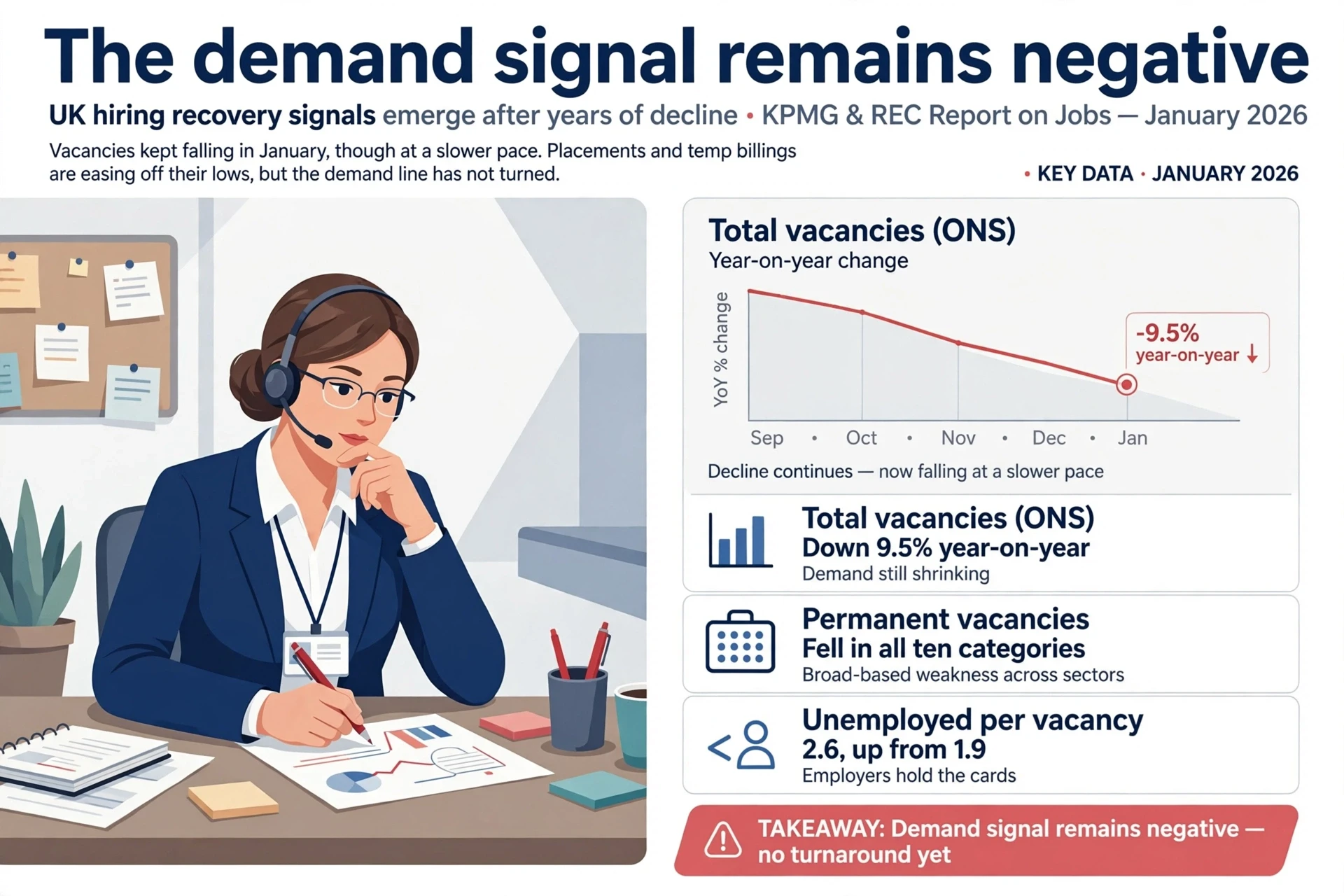
Headline vacancy figures highlight why caution remains necessary. Official ONS metrics show total UK job openings down 9.5% year-on-year, with contraction registered across 15 of 18 industry sectors.
Permanent openings remain constrained while candidate availability stays elevated. Broad-based demand has not yet returned across the wider economy.
Engineering and technical infrastructure stand out as exceptions to the pattern. Defence spending, green energy initiatives and civil infrastructure projects maintain steady demand for specialist engineering talent. Blue-collar temp placements also show localized strength.
These sector patterns represent isolated vertical demand rather than broad market recovery. Expanding agency capacity based on a single performing sector creates operational risk for multi-discipline firms.
Candidate volume does not solve specialist skill shortages
Headline candidate availability has increased significantly due to corporate restructuring and technology sector redundancies. Higher applicant volume does not make hard-to-fill roles easier to source.
Generalist job postings now attract large applicant pools, increasing admin load for internal delivery teams. Specialist technical roles remain as candidate-scarce as they were during market peaks.

Government data confirms persistent shortages across construction, digital infrastructure and specialized engineering trades. The Migration Advisory Committee continues to flag critical shortages across 28 key technical occupations.
Agency directors should evaluate desk capacity by candidate scarcity rather than raw applicant volume. A bloated database of generalist CVs does not improve placement velocity when clients demand niche technical skill sets. Modern agency ops require clear segmentation between high-volume application triage and proactive headhunting.
Five metrics to audit in your CRM before expanding capacity
National survey data offers macro context, but your agency CRM contains the micro data needed for operational decisions. Audit these internal indicators before adding biller headcount or expanding office footprint:
- Three consecutive months of perm job intake growth. Track new job requisitions added to the CRM, excluding renewed listings or aged roles.
- First-stage interview velocity. Measure the time elapsed between CV submission and client interview requests. Shorter feedback loops signal client urgency.
- Temp-to-perm conversion requests. Increased client interest in converting contract workers indicates rising confidence in permanent headcount budgets.
- Regional job requisition spread. Monitor whether new mandates are expanding beyond primary commercial hubs into regional client bases.
- Database re-engagement rates. Test how quickly consultants can identify active candidates within existing CRM records versus relying on external job boards.
Reviewing these internal operational metrics prevents premature hiring decisions based on external headline sentiment. Detailed reporting frameworks can be built using dedicated RecTech consultancy services to align operational metrics directly with business intelligence layers.
Preparing agency infrastructure for the next upturn
Scaling an agency efficiently during a market shift depends on workflow readiness. When deal flow accelerates, operational friction inside legacy recruitment systems slows delivery and inflates cost per placement.
Before increasing consultant headcount, review core recruitment infrastructure. High-performing agencies audit their database hygiene, automation workflows and integration pipelines during quieter market periods. Clean candidate records, structured taxonomies and automated candidate sourcing workflows allow existing consultants to handle higher mandate volumes without administrative drop-off.
Evaluate your tech stack performance now. Ensure your CRM workflows, data capture tools and candidate search layers function smoothly before job volumes return to peak levels.