At 10 consultants, a shared inbox and informal habits can hold a recruitment business together. At 30 consultants, that same approach creates friction, missing records and unbilled placements. Buying another software subscription rarely fixes the problem. Choosing recruitment technology for a growing consultancy requires a structured evaluation of workflows, data quality and actual desk adoption before signing long-term vendor contracts.
What growth changes about your technology requirements
Growth does not break recruitment systems instantly. It exposes the hidden workarounds consultants rely on when a database expands.
Operational symptoms of an outgrown tech stack
Watch for operational patterns across the business. Consultants keep personal spreadsheets because searching the CRM feels slower than their own memory. Management reports take hours to produce and desk heads question the figures. Multiple billers contact the same hiring manager because client activity is not visible across teams. These issues reflect systemic friction rather than individual lack of discipline. They indicate that your tech stack was built for a smaller business.
Technology priorities by agency growth stage
Agencies require different technology structures as headcount expands:
- 10 to 15 consultants: Focus on a central CRM, standard candidate tagging and consistent data entry routines across all desks.
- 15 to 40 consultants: Establish structured workflows, automated activity tracking, clear reporting pipelines and clear data rules. You can listen to our recorded conversation on recruitment tech by growth stage for more context on these transitions.
- 40 to 80 consultants: Focus on system integration, automated administrative tasks and custom data infrastructure to prevent manual overhead from stalling billings.
Building a practical selection framework
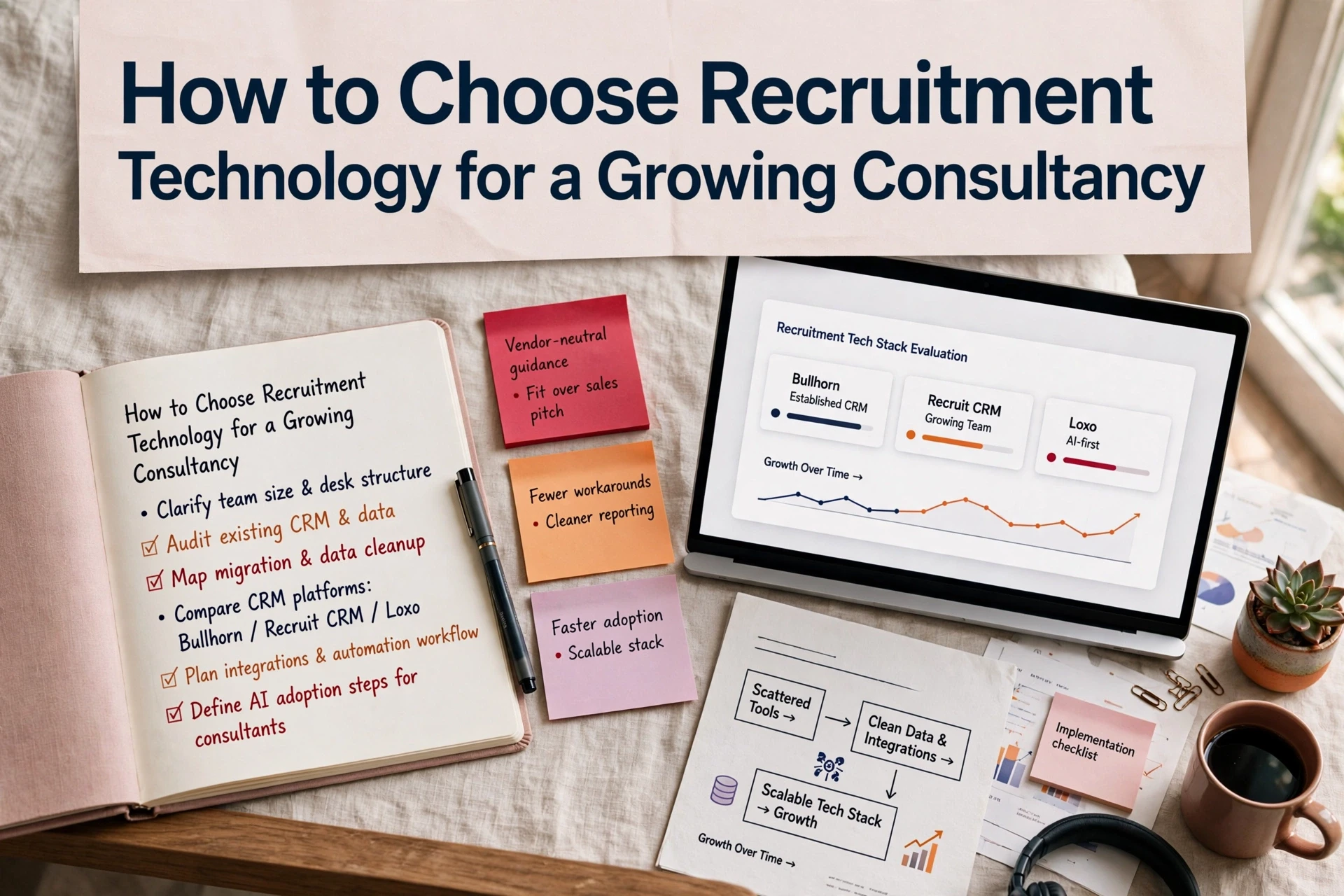
Selecting software based on vendor sales demonstrations leads to low adoption and wasted budgets. A structured selection framework relies on five practical steps:
- Identify the primary operational bottleneck in your agency.
- Map your current recruitment workflow from client brief to placement.
- Establish weighted scoring criteria with your leadership team.
- Score every software vendor against those identical criteria.
- Conduct a practical pilot with active billers before signing contracts.
Start with the primary operational bottleneck
Every recruitment business experiences a primary growth constraint. It might be administrative delay, poor candidate searchability, unreliable revenue forecasting or weak client contact records. Identify that specific bottleneck in one sentence and test every software vendor against it. Software bought to solve a defined operational issue yields measurable returns quickly. Software bought from generic feature checklists sits unused.
Map candidate and client workflows on paper
Map your actual recruitment process before shortlisting software platforms. Document every step from initial lead intake to candidate placement, fee invoicing and rebate management. Mark each operational step to retain, modify or eliminate. Skipping this step forces your agency to adapt to a vendor's rigid default workflow rather than supporting how your consultants bill.
Establish weighted evaluation criteria
Agree evaluation weights before booking vendor demos so presentation polish does not skew your decision:
- Workflow fit (30%): How closely the software matches your mapped recruitment steps.
- Consultant adoption (25%): How quickly billers can execute daily tasks without extra administrative effort.
- Reporting and pipeline visibility (20%): How accurately management can extract live operational data.
- Total cost of ownership (15%): Three-year cost including implementation, integration and data work.
- Data migration and setup risk (10%): Complexity of moving historical records without disruption.
For a detailed review of core platform criteria, read our guide on evaluating recruitment CRM software.
Core platform first: CRM before add-on tools
The recruitment CRM forms the core of your agency technology architecture. Additional tools must connect to and build upon a single system of record.

The CRM is your primary system of record
Your CRM manages client accounts, candidate histories, live placements and fee pipelines. Sourcing tools, job multiposters and analytics platforms depend entirely on its structure. Ensure you understand the distinction between an agency CRM and an in-house corporate ATS when reviewing software, as detailed in our guide on choosing between an agency CRM and a corporate ATS.
Layering sourcing, engagement and analytics software
Once your core CRM operates reliably, add supplementary software layers in order:

- Sourcing software: Tools must write candidate records directly into the CRM database without manual export files.
- Engagement platforms: Multi-channel outreach platforms must log every candidate interaction back to the central contact timeline.
- Business intelligence layers: Reporting tools should query live CRM database structures rather than relying on weekly manual spreadsheets.
Testing software with real desk scenarios
Vendor sales demos highlight perfect scenarios. Require vendors to configure a test environment using a sample of your own data. Have two senior consultants test standard daily actions: adding a candidate, updating job status, logging client calls and generating a weekly pipeline report. Observe where consultants encounter friction, as this predicts post-rollout training costs and adoption resistance.
Adding AI and automation without breaking consultant habits
Applied artificial intelligence provides practical value when focused on specific administrative overhead on busy desks.
Four high-value applications for recruitment AI
Focus AI investments on tasks that return measurable hours to billers every week:
- Candidate search and shortlisting: Identifying relevant profiles across existing CRM databases faster than manual queries.
- Administrative automation: Drafting candidate profiles, summaries and meeting notes directly inside contact records.
- Initial candidate screening: Processing incoming applications and collecting basic availability or salary details automatically.
- Client research: Gathering recent company news, hiring history and executive changes prior to business development calls.
Designing hybrid workflows for consultant desks
Fully automated workflows fail when candidate responses diverge from standard templates. Effective technology design pairs automation with consultant judgment. Automation handles high-volume repetitive tasks while consultants manage client relationships and candidate negotiations. Define clear handoff points between automated actions and human oversight before introducing new AI software.

Data readiness as the foundation for AI tools
AI tools rely on structured database quality. Inconsistent job titles, missing contact fields and duplicate records cause AI search tools to generate inaccurate matches. Before subscribing to new AI platforms, conduct a thorough data intelligence analysis to score existing records and identify missing data fields. Agencies seeking independent support on system architecture can also draw on our wider RecTech consultancy service.
Calculating total cost of ownership and migration effort
The listed seat licence fee represents only part of your total technology expenditure. Evaluating a system across a three-year lifecycle requires accounting for all associated costs.
Calculating the complete three-year cost structure
Build your investment calculation around six core components:
- Recurring seat licence fees and subscription tiers
- Implementation, system configuration and vendor onboarding fees
- CRM data migration, record auditing and field mapping
- Custom API integrations and ongoing technical infrastructure maintenance
- Consultant training programs and temporary productivity loss during rollout
- Required third-party add-ons over a 24-month horizon
Managing data migration and system transition risk
Migrating to a new system surfaces accumulated errors from historical data entry. Duplicate candidate records, incomplete work histories and uncoded client files must be flagged and prepared before migration occurs. Poorly mapped data transfers result in broken search functions and lost historical context in your new system.
Evaluate software vendor support levels prior to signing agreements. Submit technical support queries during the negotiation phase to evaluate vendor response times and technical clarity.
Evaluating your current recruitment technology stack
When an existing technology stack fails to support your agency growth, avoid buying immediate software add-ons. Review your core database structure, map actual consultant workflows across desks and establish weighted evaluation criteria before engaging with vendors. Structuring technology decisions around operational constraints ensures your stack supports long-term billing capacity.
Frequently asked questions
What selection framework should a growing recruitment agency use?
Identify your primary operational bottleneck, map candidate and client workflows on paper, establish weighted evaluation criteria, score software vendors systematically and run live scenario pilots with active billers before committing to long-term contracts.
How much should an agency budget beyond base CRM licence fees?
Agencies should budget for implementation, data migration, record remediation, custom integration builds and consultant training. These combined upfront and infrastructure costs frequently exceed the initial annual subscription price over a three-year contract.
When is a recruitment consultancy ready to adopt AI tools?
An agency is ready for AI software once its core CRM contains structured, accurate records and consultants log daily candidate and client activities consistently. Deploying AI over incomplete or duplicate database records produces unreliable outputs.
Should an agency replace its entire technology stack at once?
Phasing technology rollouts reduces operational risk. Migrate and stabilise the core CRM platform first, establish standard data entry habits across desks, and subsequently integrate sourcing, engagement and automation tools in controlled stages.