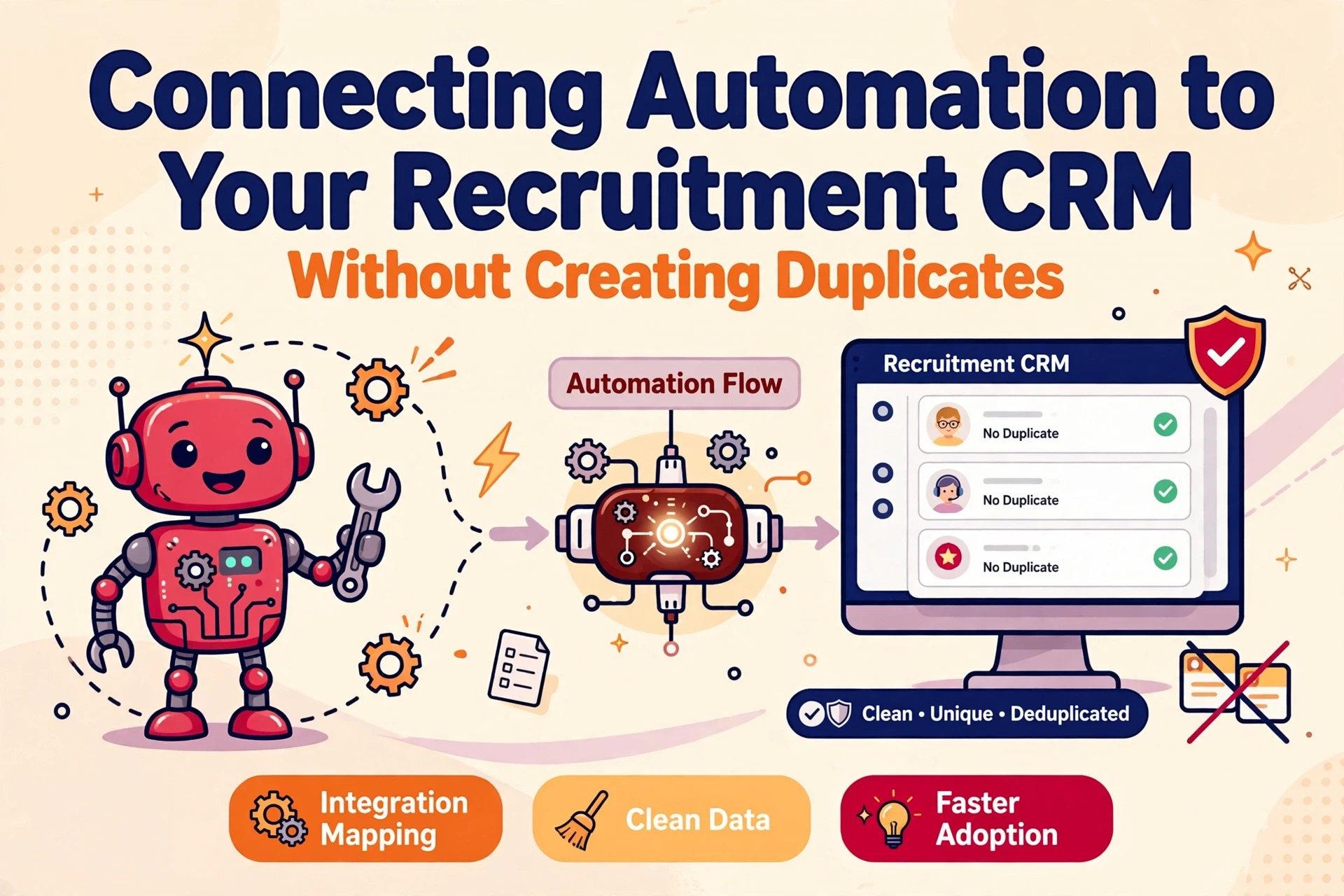
Two recruitment agencies using the same CRM and operating in the same market can produce entirely different reporting figures. The issue is rarely the software package. It is the data held within it: inconsistent job titles, missing placement dates and unread notes. Most agencies track excessive filler fields while omitting the specific contact and pipeline records that power reporting and AI workflows.
What a recruitment agency database is actually for
System of record, not a contact list
Your database is the definitive source of truth for client, contact and candidate records. Names and phone numbers are only the baseline. The real value sits in what each record documents: who made contact, at what stage, and why a placement progressed or stalled. When this history remains inside the CRM instead of consultant email threads, the business operates without reliance on individual memory.

Why record quality decides report quality
CRM reports reflect underlying record quality. Incomplete stages, stale job titles and duplicate contact records reduce pipeline figures to rough estimates. Any AI application connected later inherits these exact blind spots. Resolving record completeness at the field level ensures that CRM reporting delivers actionable insight. Field selection matters far more than vendor choice.
The core record sets to track
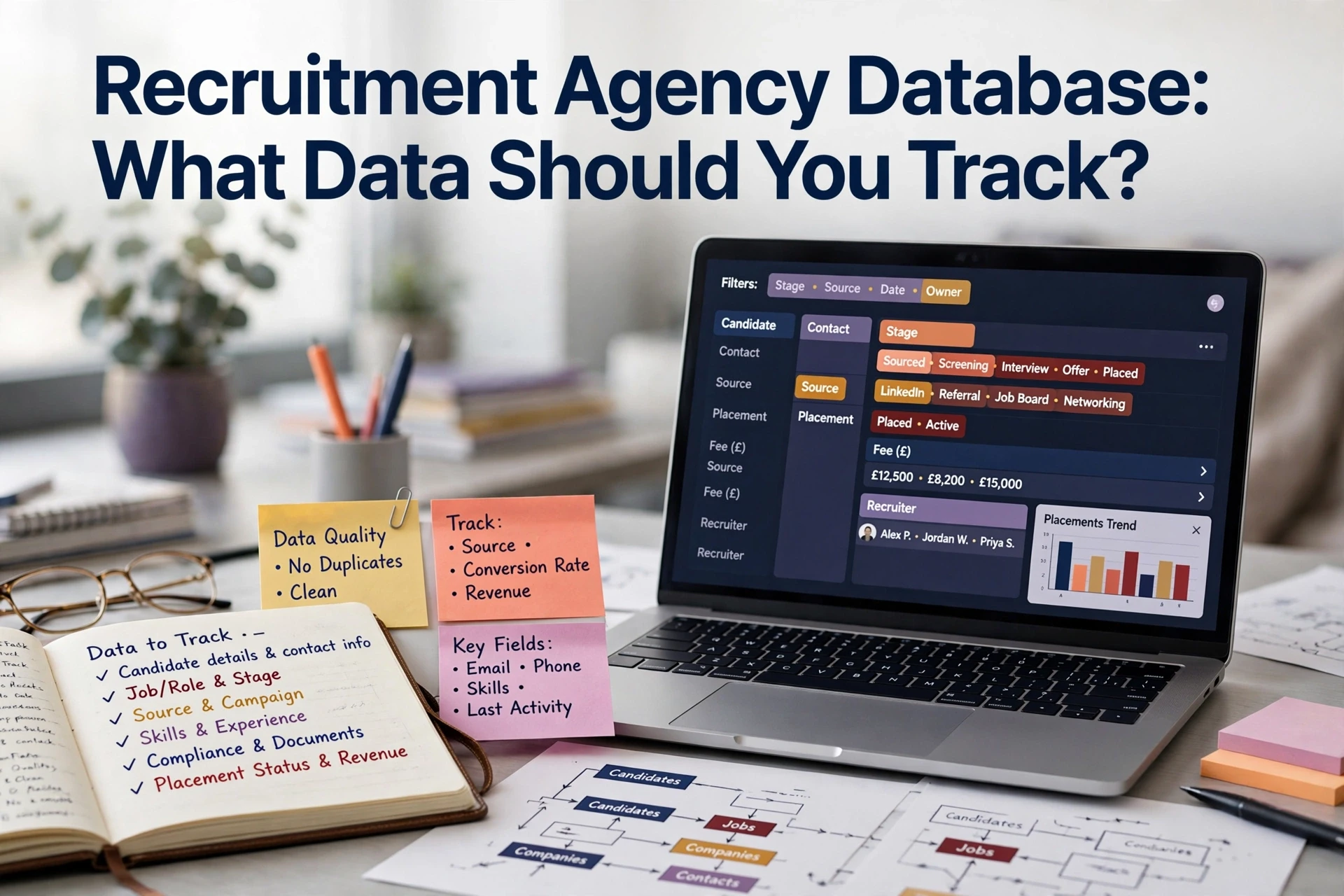
A practical recruitment agency database relies on six core record sets:
- Client companies: sector, headcount, locations, fee structures and billing terms.
- Client contacts: full name, current role, direct phone line, email address and account notes.
- Candidates: skill tags, compensation expectations, work history, right to work and consent status.
- Vacancies: role description, salary or daily rate, pipeline stage, target start dates and fee structure.
- Activity and pipeline: logged calls, CV submissions, interviews, job offers and placement outcomes.
- Consent and source details: origin of the record and explicit usage permissions.
These record sets form the foundation for reporting and AI work. If one set remains incomplete, downstream reporting breaks.
Client and contact data
Structure client contact records across three distinct layers:

- Identity: full name, exact job title, direct email, phone number and assigned organisation.
- Commercial details: agreed fee percentage, credit terms, historic placements and live vacancies.
- Relationship history: date of last contact, preferred channel and internal account owner.
Keep company and contact records connected but distinct. Staff turnover at a client company should never break the account history.
Candidate and talent data
A candidate database requires skills coding, salary expectations, location boundaries, right to work status and compliance checks. Include concise summary notes written for colleague reference rather than personal shorthand. Consent tracking is as critical as skill tagging, because a contact without valid outreach permission carries no operational value. Most agencies hold this information, but inconsistent desk habits create gaps.
Jobs and vacancies
Vacancy records track placement revenue and require structured entry. Capture job title, sector classification, contract type, pay rate, stage status, shortlist counts, start dates and agreed fee. Link every vacancy to the correct client company and contact so pipeline reports aggregate properly. Maintain complete stage progression history to identify where deals stall.
Activity, pipeline and outcome data
Log every client and candidate touchpoint: calls, meetings, CV submissions, interviews, offers and placements. Record outcomes alongside activity, including reasons for lost deals or lapsed roles. AI applications rely on structured activity patterns. Unrecorded consultant activity restricts what automation tools can process later.
Consent, suppression and source data
UK data protection regulations require a defined lawful basis for processing records. Document record origin and valid consent boundaries. Keep suppression flags visible to prevent contact with opted-out individuals. Practice data minimisation by storing data actively used rather than speculative details. Flag duplicate contact records for manual review rather than attempting automatic merges that risk overwriting placement history.
Reactivating a dormant candidate database only works when consent and source data were tracked from the start.
Scoring, enriching and completing existing records
Fixing database records works best in three ordered steps. First, run a data analysis that scores contact records for completeness and ideal client fit. Second, enrich incomplete fields using existing internal files like email signatures and CV documents, or through targeted external projects. Third, flag duplicate contact records and naming variations for review.
Score contact records before enriching them
Before adding external data, score contact records against essential operational fields: organisation name, contact identity, job role, sector focus and location. Weigh each field to produce an overall quality score. High-scoring records are ready for desk use, while low-scoring records require review. We detail this scoring structure in our guide to building a data intelligence strategy. Completeness scoring provides clear direction on where consultants should focus, built on the principles behind scoring CRM leads without losing context.

Enrich records from existing assets
Agencies often hold missing details within existing assets. Email signatures confirm current job titles and direct lines, while historical CVs contain qualifications and location history. Extracting this internal information fills gaps without purchasing new data. When external enrichment is required, focus on specific contact records needed for active business development. Our data intelligence service carries out this analysis to score contact records against ideal client profiles. Note that mobile numbers sit outside enrichment scope, and new details should complement consultant notes rather than overwrite them.
Resolve duplicate contact records and naming drift
Duplicate contact records split pipeline history and fragment account records. Naming drift causes similar reporting errors when consultants log variations like "BT Group" and "BT plc". Automated merge rules frequently misinterpret matches and risk combining distinct records. Flag duplicate contact records for human review so consultants can evaluate context before taking action.
Turning tracked data into decisions
The questions your database should answer
Define reporting needs before choosing optional database fields. Identify which accounts generate recurring requirements, which desks convert shortlists fastest and where roles stall in the pipeline. Fields that answer these core operational questions earn their place in the CRM. Unused fields add system complexity without commercial gain.
Extracting data from the CRM
Standard CRM dashboards handle daily operational metrics, while executive reporting often requires data extraction. Modern CRMs provide API endpoints or scheduled exports to feed central reporting layers, combining CRM activity with financial metrics. Structured exports into a secure database or reporting model outperform complex internal dashboards. When structuring custom reporting environments, we deliver this infrastructure within our data intelligence service service.
What makes data ready for AI
AI adoption depends on underlying data quality. First, maintain standardisation across job titles, sectors and pipeline stages. Second, ensure completeness across contact identities, company structures and deal records. Third, log dated activity history and notes to provide context for AI models. Unstructured or incomplete records produce vague AI outputs, so structure database records before deploying AI tools.
UK data protection rules for agency data
The UK GDPR requires adherence to principles of minimisation, accuracy, storage limitation and security. The ICO guidance outlines how these principles govern recruitment data handling.
Data minimisation and field selection
Collect data tied directly to a clear recruitment purpose. Additional fields create maintenance overhead and require justification under candidate access requests. Data minimisation improves record completion rates. Fewer mandatory fields encourage consistent entry across desks, supporting better reporting and AI readiness.
Accuracy, retention and access permissions
Maintain accurate records and apply suppression flags when retention limits are reached. Log consent source details to justify historic outreach. Restrict database access permissions based on role requirements, and conduct annual permission reviews to remove outdated access rights. Flag duplicate contact records for review rather than removing them without verification.
Next steps for database optimisation
Review your current CRM fields against your reporting requirements. Identify unused custom fields and flag incomplete contact records for review. Establish standard tagging across desks for job titles and pipeline stages before connecting automated workflows or external reporting tools.
Frequently asked questions
What core record sets should a recruitment database contain?
A recruitment agency database should hold six core record sets: client companies, client contacts, candidates, vacancies, activity pipeline history and consent records. Tracking these sets consistently provides the data structure required for operational CRM reporting and future AI deployment.
How often should an agency score contact records for completeness?
Score contact records prior to any data enrichment project and review completeness metrics quarterly against a fixed field list. Regular scoring highlights missing fields across desks and ensures business development lists rely on complete contact information.
Why should duplicate contact records be flagged rather than automatically merged?
Automated merging tools often combine records based on simple name or email matches, which can overwrite historic notes or assign contacts to the wrong organisation. Flagging potential duplicates allows consultants to review history and maintain accurate account structures.
What makes CRM data ready for AI tools?
AI models require standardised field entries, complete contact details and dated activity logs to detect patterns. Inconsistent job titles or missing pipeline stages produce unreliable AI outputs, making data standardisation essential before software rollout.