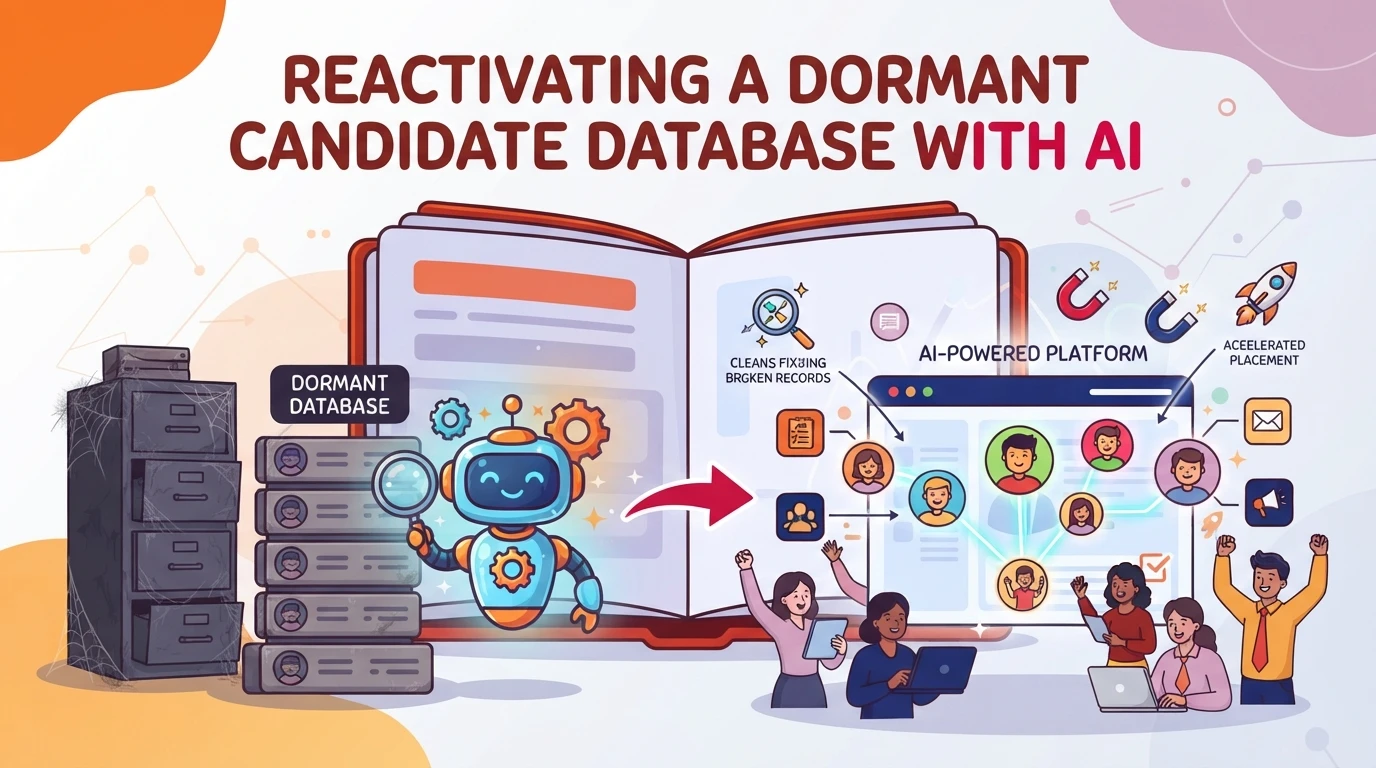
Most recruitment agencies sit on tens of thousands of candidate records they have already paid to acquire. Over time, contact details go out of date, job titles become inconsistent, and consultants default to buying fresh candidates from external job boards. AI candidate reactivation offers a practical way to turn dormant database records into active job pipeline. By automating list segmentation and initial messaging, agencies can focus consultant time on warm, high-intent conversations.
The hidden cost of abandoning existing candidate records
Agencies spend substantial budget every year on job board subscriptions, LinkedIn licences and advertising campaigns. Yet within 12 months of initial contact, most candidate profiles inside the CRM fall out of active view. Consultants rarely search beyond the top few pages of recent entries.
This creates a costly cycle. Desk heads request more spend for candidate acquisition while thousands of qualified professionals already exist in the agency database. The problem is not a lack of candidate interest. It is the administrative burden of identifying who is available and reaching out to them individually.
Manual database campaigns consume hours of consultant time for unpredictable reply rates. When billers have to pick between cold calls to stale lists and running fresh searches on job boards, they choose job boards every time. Automated workflows solve this friction by taking over initial outreach at scale.
Preparing CRM data for automated engagement
Before launching any automated campaign, candidate data must be structured so automated tools can process it accurately. Searching across unstructured text fields or inconsistent job titles leads to irrelevant outreach that damages agency reputation.
Start by addressing duplicate entries. If a candidate exists three times with slightly different email addresses or names, messaging tools may send conflicting communications. Standardising key fields is equally critical. Free-text job titles like "Senior Lead Developer" and "Tech Lead" should map into clear, standardised tags that reflect core desks.
Avoid over-complicating mandatory fields for your recruitment team. Requiring consultants to complete dozens of drop-down menus on data entry creates resistance and leads to poor data quality. Focus instead on a small set of high-value data points: standardised specialism tags, current location, candidate availability and last contact date. Our data intelligence service evaluates every database record against these core fields to show which segments are ready to work on.
Building an AI outreach workflow that consultants actually use
Automated candidate engagement works best when it supports consultant habits rather than trying to replace them. Across more than 100 CRM implementations, we find that adoption drops whenever a tool attempts to automate the entire placement cycle.
The workflow should split clearly between automated processing and human interaction. AI tools handle record segmentation, draft personalised messages and monitor incoming responses. Consultants take over the moment a candidate shows interest.
A successful campaign follows four distinct steps:
- Segment the database by skill, geography and tenure in current role.
- Generate tailored message drafts that reference specific candidate experience and market context.
- Present outgoing drafts to consultants for rapid review and approval.
- Route positive replies directly to the consultant inbox or task list for immediate phone follow-up.
This structure keeps your team in control of the candidate relationship. Consultants spend their time speaking with candidates who have actively expressed interest, rather than working through cold call lists. For further discussion on structuring desk workflows, listen to our recorded conversation on process before automation.
Managing compliance and candidate consent under UK regulations
Automated outreach must comply strictly with UK data protection legislation, including UK GDPR and PECR. Candidates must understand why they are being contacted and how your agency obtained their information.
Legitimate interest often serves as the lawful basis for contacting past applicants about relevant roles. However, this requires a documented assessment balancing commercial interest against individual privacy rights. You can review current guidance directly on the Information Commissioner's Office website.
Opt-out management requires careful technical setup. When a candidate requests removal from future communications, their record must be suppressed rather than completely erased. Complete deletion creates a risk that the candidate will be re-imported during a future data enrichment project. Maintaining an explicit suppression list ensures candidates who opt out are never contacted again.
Keep human oversight on all engagement decisions. Automated tools should never make final screening or rejection choices without consultant review. Maintaining a human in the loop protects your agency against compliance risks while maintaining high candidate experience standards.
Setting realistic metrics and channel expectations
Reactivating old candidate records is not an instant fix, but it provides a highly predictable sourcing channel when measured correctly. Agencies should track cost per placement rather than focusing solely on reply rates or message volumes.
Compare total investment in automation and data preparation against traditional advertising costs. Sourcing a placement from your existing database avoids external job board fees, directly improving margin on each placement made.
Pay attention to three core metrics during early campaigns:
- Delivery and open rates to verify contact data accuracy.
- Positive reply rates to evaluate messaging relevance.
- Conversion time from initial reply to candidate submission.
Review channel performance quarterly. Early campaigns provide data on which candidate segments respond best to outreach. Desk heads can then refine their targeting rules and expand automated campaigns into adjacent specialisms. For broader advice on building sustainable tech stacks, explore our wider recruitment technology consultancy options and our recruitment tech blog.
Frequently asked questions
How does AI candidate reactivation work in practice?
AI candidate reactivation scans your database to identify dormant candidate profiles, groups them by skill and tenure, and generates tailored outreach messages. When candidates reply expressing interest in new opportunities, the system routes the message to the responsible consultant for a phone call. This removes manual admin while keeping consultants in charge of relationships.
What data preparation is required before starting a reactivation campaign?
Before launching outreach, you must address duplicate records and standardise key search fields. Replace free-text job titles with structured tags and confirm that candidate contact details are formatted correctly. Prioritise high-value segments first, such as candidates placed two to four years ago, rather than attempting to update every record at once.
How should recruitment agencies measure ROI on reactivated database records?
Measure return on investment by calculating cost per placement for reactivated candidates against external job board sourcing. Track open rates, positive reply rates and submission speed to gauge campaign health. A single placement from reactivated database records usually offsets the software costs incurred for the campaign.
What are the UK compliance requirements for automated candidate messaging?
Automated outreach must comply with UK GDPR and PECR regulations. Agencies must establish a valid lawful basis, such as legitimate interest, and provide a clear opt-out mechanism in every message. Candidate opt-outs should be added to a suppression list to prevent accidental re-contact during future data imports.