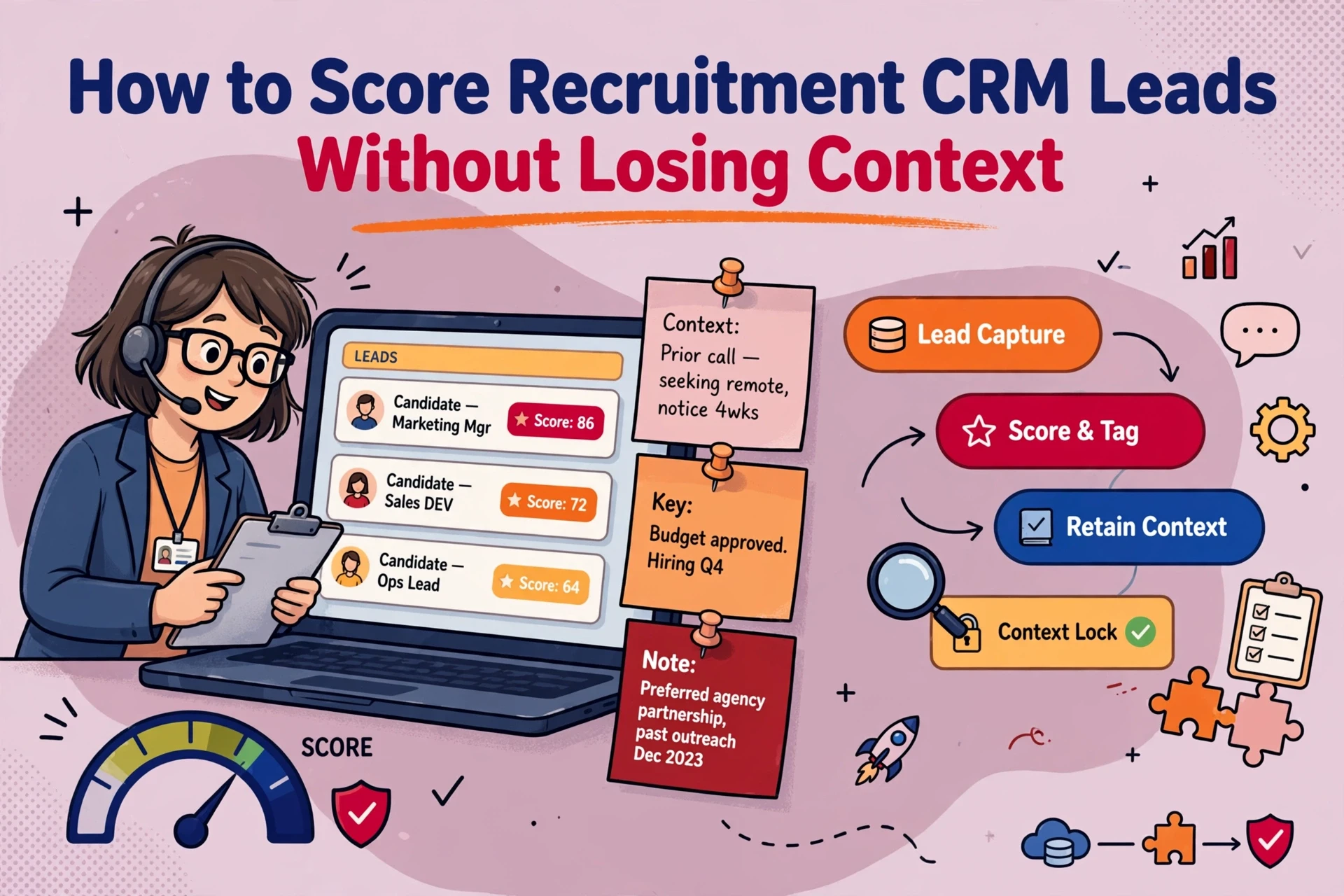
Recruitment CRM lead scoring fails when it rewards recent activity over proven relationships. A hiring manager who briefed your agency twice gets ignored while a new web enquiry with three clicks jumps the queue. When consultants see numbers that contradict common sense, they stop using the CRM.
Lead scoring in agency recruitment only works when the score stays tied to context: what the contact said, what role they need filled, and what action the consultant should take next. Scoring by numbers alone shows who looks active, not who is worth a call.
Here is how to set up lead scoring in your CRM that keeps relationship context intact and gives your team actionable priorities every week.
Define scoring rules for clients and candidates separately
A client lead and a candidate lead represent completely different commercial realities. Mixing them into a single scoring system produces numbers that mean nothing to your consultants.
Client leads signal opportunity through hiring volume, sector alignment, fee potential and urgency. Candidates signal fit through specialised skill sets, notice periods, location and salary expectations.
Keep candidate scores and client scores in separate fields or separate record types within your system. Whether your agency runs Bullhorn, Vincere, Loxo or Mercury, your database structure must distinguish candidate engagement from client intent. A consultant looking at a record should understand within seconds what the number represents and why it changed.
Every score band needs one required operational action. A score without an assigned task is just a vanity metric. Define what each band demands from the desk:
- High client score: Book a call within 48 hours.
- Mid score: Add to a target account email sequence.
- Low score: Schedule a quarterly check-in.
When carrying out a CRM implementation, configure your workflow automation so score updates generate tasks without hiding historical notes.
Build scores from fit, intent and relationship context
A usable lead score combines three distinct layers: fit, intent and relationship context. Fit determines whether a contact is worth pursuing. Intent determines when to make contact. Context prevents your team from treating an established client like a cold lead.

Assess firmographic and desk fit
Start with clear criteria: sector, company size, hiring frequency and typical fee level. Weight these criteria against the desks that drive your core billings. A client hiring eight perm engineers a year in your niche outranks a one-off contract request outside your focus area, regardless of how urgent the isolated request appears.
Keep your fit criteria simple. Three or four data points scored on a 0-to-2 scale provide enough granularity for recruitment businesses. Because company fit rarely changes from week to week, review fit scores quarterly.
Track behavioural intent signals
Intent measures what a prospect is doing right now. Weight direct responses above passive digital footprints. A client replying to an email campaign, posting a live job opening on their site or asking for fee structures indicates higher intent than someone who updated their job title on LinkedIn.
| Intent signal | Score weight | Operational meaning |
|---|---|---|
| Direct reply to outreach | High | Active requirement, schedule a call this week |
| Multiple job site views | Medium | Active research, assign to nurture workflow |
| Change of job title only | Low | Profile fit signal, not an immediate buying signal |
Review these weights monthly. Remove signals that do not correlate with actual revenue opportunities.
Incorporate relationship history
A high score on a client record where your agency had a broken placement six months ago is not a warm lead. Overlaying relationship context requires checking previous contact dates, placement history, open disputes and consultant notes before setting priority.
Ensure high scores display alongside the three most recent CRM notes and a named next step. Scoring identifies who to contact; context dictates what to say. Maintaining this underlying record quality requires a clear data intelligence strategy.
Preserve context fields alongside automated scores
A lead score is a summary tool, not a replacement for narrative context. Automated scoring should never overwrite activity logs or consultant comments.
Store three distinct data elements on every contact record: the numeric score, the automated reason for the score, and the manual notes from previous interactions. Create custom fields for the numeric score and automated reasoning, leaving consultant notes completely untouched.
Never allow background automation to alter or delete consultant notes. A consultant entry detailing a client budget freeze in Q4 holds more practical value than a point increase triggered by automated web tracking.
Run score recalculations on a predictable schedule, such as nightly or weekly, rather than on every minor record update. Scheduled recalculations prevent numbers from fluctuating while consultants are actively managing pipeline.
| Score band | Defined review action | Assigned role |
|---|---|---|
| Hot | Book a call within two business days | Account consultant |
| Warm | Add to monthly targeted outreach | Business developer |
| Cool | Re-evaluate next quarter | Operations / Resourcer |
| Dormant | Review for database archiving | Operations lead |

Review score distribution quarterly. If more than 40% of your records sit in a single band, recalibrate your scoring thresholds.
Measure scoring accuracy against placement outcomes
No lead scoring model is perfect at launch. Treat your initial weights as working hypotheses that require validation against closed deals.
Compare scores against desk actions
Audit a sample of scored leads each month. Check whether high scores led to conversations and whether low-scored contacts generated unexpected job briefs. A high score that produces no commercial engagement indicates an overweighted intent signal.
Look closely at missed revenue opportunities. A low score assigned to a client who subsequently placed a retainer elsewhere highlights a gap in your fit or intent criteria. Involve senior billers in these reviews to identify where model logic diverges from desk reality.
Adjust criteria systematically
Modify one scoring variable at a time and observe performance over a full monthly sales cycle before making further changes. Adjusting multiple criteria simultaneously makes it impossible to isolate which change improved accuracy.

Maintain a simple change log recording the date, specific weight adjustment, and commercial rationale for every modification. This log provides transparency when consultants question score changes and ensures system continuity as your operations team evolves.
Deciding your next CRM scoring step
Start by auditing your current CRM data structure before setting up scoring rules. Confirm your system separates candidate records from client contacts and that consultant notes occupy distinct, protected fields.
Once your data fields are organised, select five client intent signals to test on a single desk. Validate that consultants agree with the resulting priorities before expanding scoring across the rest of the business.
Frequently asked questions
How do you set up recruitment CRM lead scoring without losing context?
Configure your CRM to store numeric scores, automated scoring reasons, and manual consultant notes in separate fields. Ensure background automation never overwrites activity notes. Display recent activity notes directly alongside the score so consultants see the relationship history behind the number before making a call.
Which lead scoring signals matter most for recruitment agencies?
Direct two-way interactions matter most. Weight email replies, job specification downloads, and confirmed hiring briefs highest. Passive signals like single page visits or job title updates should carry lower weight because they indicate general profile fit rather than immediate hiring intent.
How often should an agency review CRM scoring rules?
Review scoring rules monthly for the first quarter after launch, then move to quarterly reviews. Audit a sample of scored leads against actual placement outcomes to verify that high scores correlate with real commercial opportunities, adjusting one scoring weight at a time.
Who should manage lead scoring rules in a recruitment agency?
Operations or tech leads should maintain the technical rules and field mappings in the CRM. Desk heads and top billers must review and approve the scoring weights to ensure the system reflects real hiring manager behaviour.