The gap between industry reports and real CRM usage
Most market reports on recruitment technology measure how agency leaders feel about software rather than whether consultants actually use it. High login counts and long feature lists mean little if team members still run their desks from personal notebooks, spreadsheets or inbox folders. Real adoption shows up in clean data, completed follow-ups and candidate records that another consultant can act on without a verbal handover.
Industry survey reports frequently mix two separate things: leader optimism and daily software usage. While confidence surveys show how agency owners view market growth, optimism does not reflect how staff log candidate interactions. A survey showing high software investment indicates spend, not daily compliance.
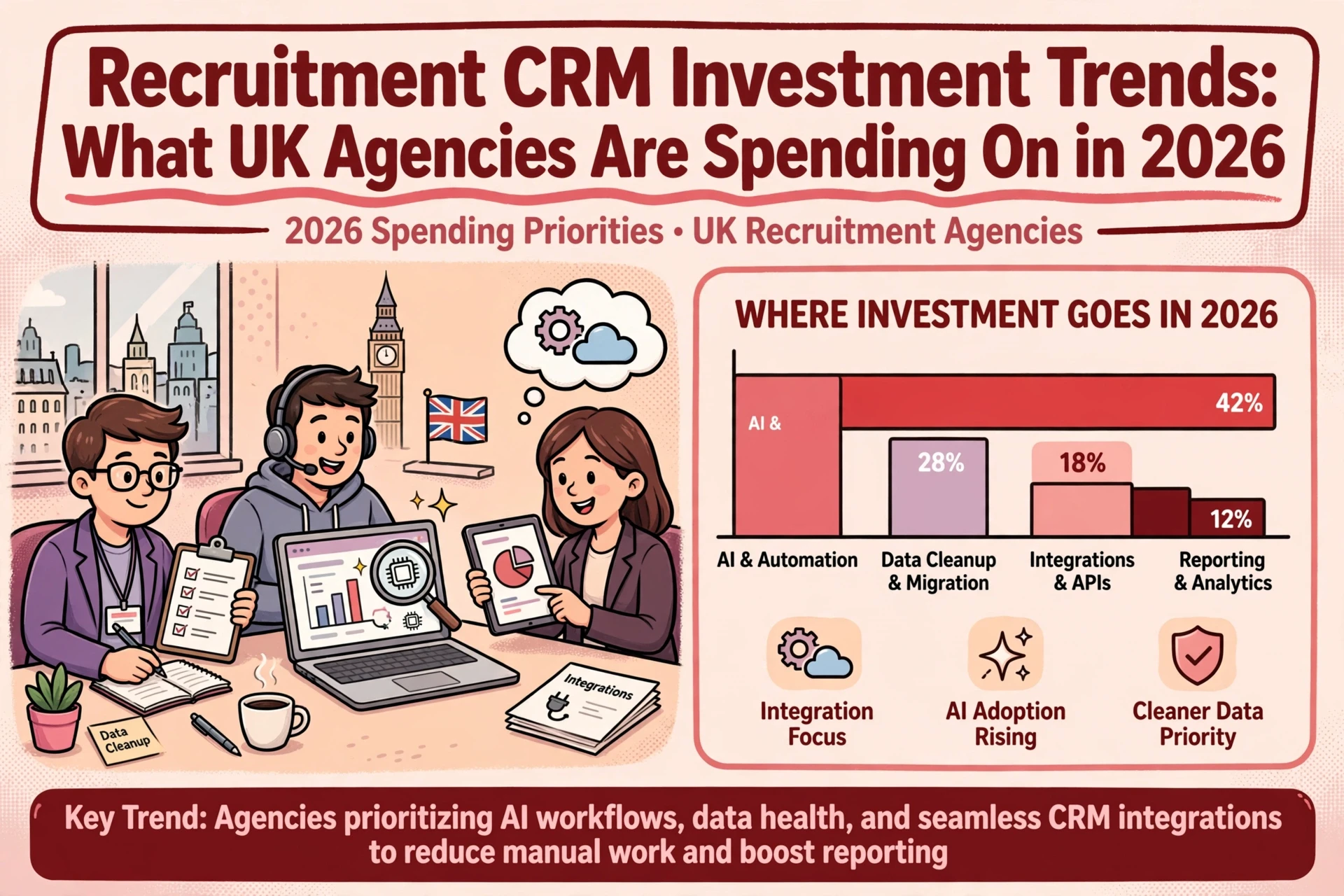
Where published research offers clearer direction is on system connectivity. A report from the Recruitment and Employment Confederation highlights that joining CRM, screening and pay and bill systems reduces manual administration. Connecting systems speeds up data transfer, but connecting bad data simply moves inaccurate records around faster. If consultants do not log conversations accurately in the primary CRM, integration automates gaps rather than solving them.
Practical signals of genuine CRM adoption
Dashboard metrics often create a false sense of security. Software licence activity shows who opened the system, but it does not reveal whether consultants called candidates back or kept records updated.
Agency leaders looking for honest adoption signals should review four specific operational behaviours:
- Follow-up completion rates. The proportion of scheduled tasks, interview check-ins and client call-backs marked complete on time.
- Record legibility. Notes written during or immediately after a call with enough detail for a colleague to handle the account.
- Search accuracy. Whether candidate records use standardised job tags rather than free-text job titles that hide records from search filters.
- Database freshness. The percentage of records untouched for 90 days or more without clear status tags.

A database filled with brief, unhelpful notes is a passive directory rather than an active sales system. When candidate profiles lack context, consultants revert to phone calls and personal notes, bypassing the central CRM.

Where patchy usage persists across the agency, leaders need to distinguish between poor habit enforcement and software that fits the agency poorly. Our guide on when a recruitment agency should replace its CRM outlines the key criteria for evaluating system fit against internal operational issues.
Why CRM adoption breaks after roll-out
Agencies rarely fail with software because they selected the wrong platform name during procurement. Adoption stalls in the months after implementation when extra steps slow down daily work.
Administrative friction drives consultants away
Consultants prioritise billing activity. If recording a candidate call requires six mandatory dropdowns, four screen transitions and duplicate data entry, billers will record notes elsewhere.
Over-configuring mandatory fields is a frequent cause of system abandonment. When management forces consultants to fill in dozens of required fields during candidate registration, team members enter junk text or pick the first item in every list. Reducing mandatory fields to four or five high-value data points restores search reliability and lowers entry friction.
Unclear purpose turns systems into admin taxes
Adoption also drops when agency leadership frames the CRM primarily as a monitoring tool for management reporting. If billers believe system entries exist only to verify activity levels, compliance remains low.

Demonstrate how structured data directly benefits the biller. Showing a consultant how structured skill tags bring up ten qualified, available candidates in five seconds builds far more trust than mandating daily activity metrics.
How to audit adoption in your agency
Evaluating software usage requires reviewing actual records rather than relying on consultant surveys or high-level login reports. Agency leaders can assess adoption using a three-step audit:

- Pull 10 active candidate files. Select ten candidate records updated in the past fortnight. Read the recent activity log. If a colleague cannot understand the candidate situation without calling the primary consultant, record quality is insufficient.
- Run a core candidate search. Search your database for a common specialism using standard filters. If search results fail to surface suitable candidates because of free-text job titles or missing tags, data structure is blocking adoption.
- Trace a recent placement end-to-end. Select a candidate placed in the last month and review their timeline in the system. Check whether screening notes, client submissions and interview feedback sit inside the CRM or across external email threads and personal documents.
If your audit reveals widespread gaps, review our CRM guide for UK agencies or explore our independent rectech consultancy services to establish cleaner data structures.
Practical steps for agency leadership
Fixing CRM adoption requires addressing daily habits and workflow structures rather than buying additional software modules.
Start by streamlining the data entry process. Cut mandatory candidate fields down to essential contact, compliance and skill tags. Standardise job titles into a consistent taxonomy so searches return accurate candidate cohorts. Finally, replace raw login tracking with behavioral metrics, focusing on follow-up completion rates and record completeness.
Agencies that simplify data collection and align system workflows with desk routines build databases that consultants actually use.