A software vendor shows you an AI matching engine that pulls three candidate records for a senior vacancy in seconds. The pitch looks convincing. Then you look at your pipeline and find those candidates were already on your database, untouched for six months, because the software was never tied to how your consultants work.
That divide between vendor presentations and daily desk activity is the main pitfall with artificial intelligence recruitment software. Most products are judged on what they demonstrate using pristine demo files, not on what they deliver when plugged into your existing database.
Evaluating these platforms requires a vendor-neutral framework that links every headline capability back to your CRM records and daily workflows. It also requires an understanding of UK data protection standards, because agency leaders remain accountable for automated decisions affecting candidates.
Where AI software earns its keep on a recruitment desk
Strip away the presentation theatre and artificial intelligence recruitment software earns its keep in three areas. First, candidate identification: search and ranking that surface relevant people already sitting in your CRM. Second, consultant admin: draft creation for client submissions, call note summarisation and booking follow-ups. Third, data management: enriching contact records and scoring completeness so your database remains usable.
Every other capability on a feature matrix is an offshoot of those three. When you evaluate any platform, test the data dependencies immediately. A matching algorithm fed incomplete candidate records or obsolete job titles will consistently produce poor recommendations.
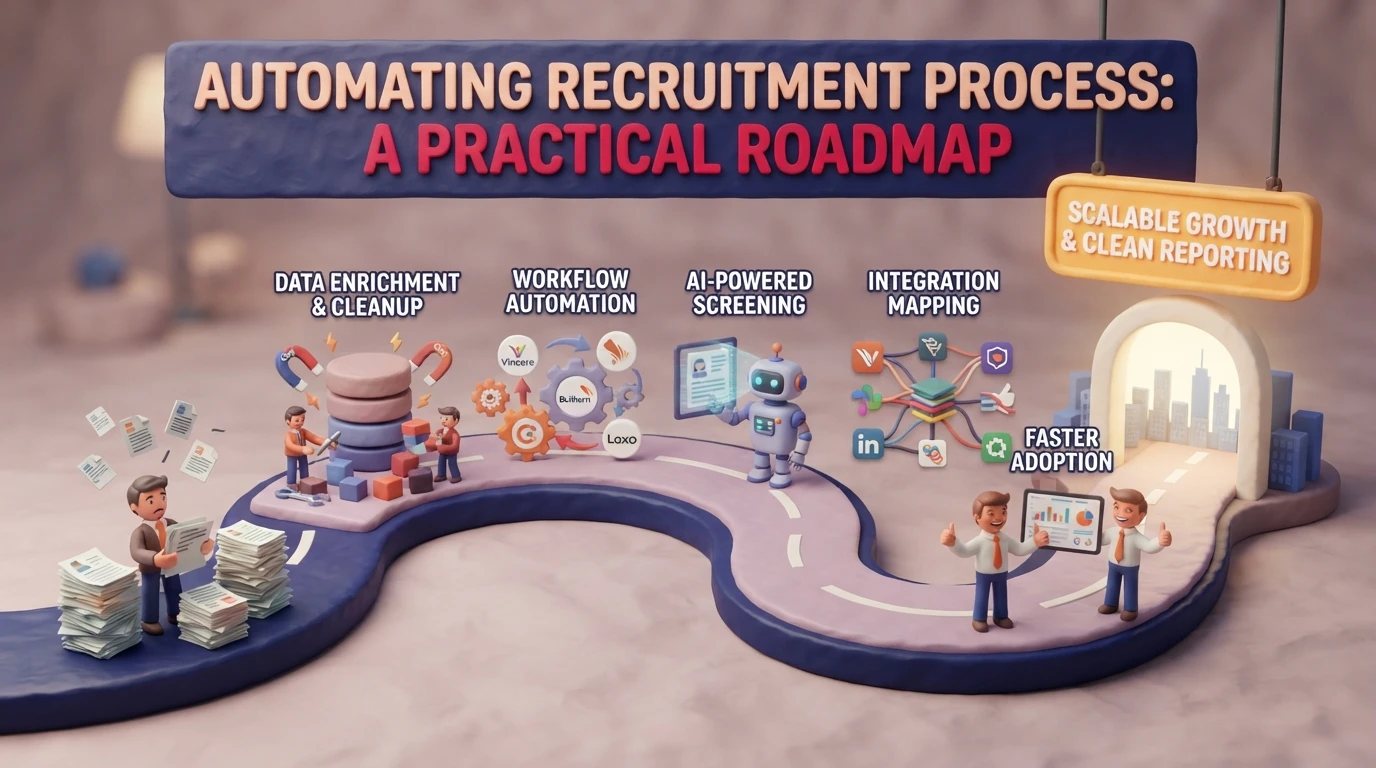
In an agency of five to 80 consultants, fee earners spend substantial portions of their week updating records, drafting candidate summaries and checking availability. Process automation often delivers returns faster than complex machine learning models. Our review of automation workflows that save consultant time highlights this balance: standardise the underlying workflow first, then add assistive AI tooling where it removes friction.
What features should artificial intelligence recruitment software have?
The features that justify investment fall into five core areas: candidate matching based on your internal CRM records, sourcing connected to your active channels, draft generation with human review, pipeline automations tied to stage movements, and operational reporting your team trusts.
Each function depends on your data foundation:
- Candidate matching. Shortlist generation requires accurate records showing skills, work history, location preferences and rate expectations. Match algorithms run against thin data produce flawed recommendations.
- Sourcing and enrichment. Contact discovery works when it resolves specific data gaps on active vacancies, rather than adding thousands of unverified records that your consultants never contact.
- Drafting assistance. Drafting outreach messages, job adverts and candidate submission profiles saves time. A consultant must review and approve every message before sending.
- Workflow triggers. Task reminders, status updates and chase messages operate on defined conditions. This delivers dependable productivity gains because it relies on existing CRM activity data.
- Operational reporting. Analytics dashboards reflect the placement stages and activity notes your consultants log.
Capabilities that struggle in live agency environments
Certain product features sound compelling in sales pitches but encounter friction in production:
- Unsupervised applicant screening. Screening entire candidate pools without human intervention carries compliance risks and frequently filters out viable candidates when CV formats vary.
- Autonomous workflow agents. Systems marketed as managing client relationships end to end require manual review, editing and oversight at each stage.
- Predictive placement scoring. Statistical prediction requires thousands of structured placement records. Small and mid-sized agencies rarely hold the volume needed to make algorithmic predictions reliable.
Examine what happens when these features process your current volume, rather than the supplier's pre-configured demonstration database.
Functions smaller agencies can defer
Automated video or voice interviewing rarely justifies the investment for agencies with fewer than 80 fee earners. Initial screening remains a critical relationship-building stage with candidates. Spend your software budget on matching, sourcing workflows and administrative efficiency first.

UK data protection and automated decisions
Evaluating compliance for artificial intelligence recruitment software does not mean asking whether AI is permitted. It means identifying what the system does with personal data, who reviews automated outputs and where records are processed.

Regulatory expectations for candidate data
The Information Commissioner's Office considers software that ranks, filters or scores candidates as processing personal data under UK GDPR. If a system takes action on an applicant without genuine human intervention, that qualifies as automated decision making.
Agencies must maintain transparency and oversight:
- The system must show what data inputs it uses and explain the criteria used to reach a recommendation.
- Consultants must have the ability to review, understand and override software suggestions before they impact a candidate.
- Records used by the software must be accurate, because outputs derived from stale or duplicate data create defensibility issues.
The ICO publishes detailed guidance on automated decisions and data legislation that sets out organisational responsibilities.
Safeguards for automated processing
Under UK legislation, including provisions under the Data (Use and Access) Act, agencies adopting automated assessment tools must maintain specific procedural safeguards:
- Candidates must be informed when automated systems are used to assess or filter their applications.
- Individuals must have a clear route to request that a qualified consultant review any automated assessment.
- Candidates must be permitted to make representations and contest decisions reached through automated scoring.
A consultant confirming an automated shortlist without reviewing the candidate profiles does not meet the standard for meaningful human review.
Hosting infrastructure and third-party processing
Data location matters, but sub-processor chains require equal scrutiny. Many recruitment tools pass CV data, candidate notes and salary details to external model providers via API connections.
Before entering an agreement, confirm three points with the software provider:
- In which data centres is your agency data stored and processed?
- Which sub-processors receive candidate personal data, and what agreements govern their access?
- Is candidate or client data used to train the vendor's models or third-party foundation models?
If a supplier retains the right to train public models on your proprietary records, that presents commercial and confidentiality risks.
How should a recruitment agency test AI software before signing?
Vendor demonstrations show optimal scenarios using prepared files. To validate whether software functions on your desks, conduct a structured trial prior to signing a long-term agreement.

Follow a clear pilot sequence:
- Select a single workflow, such as candidate database matching on a live assignment.
- Load an unedited export of your own CRM records, including incomplete entries.
- Define an objective evaluation measure, such as relevance scores determined by experienced consultants.
- Run the trial for two weeks with the fee earners who will use the tool daily.
- Review the outcomes against your baseline measures before making a purchasing decision.
Our guide on how to pilot an AI recruitment tool details how to run these evaluations across specific recruitment desks.
Put direct operational questions to the software provider:
- Which specific fields in our CRM does this feature require, and what does it output when those fields are unpopulated?
- Can we export generated outputs and data structures if we discontinue the service?
- How does the platform log consultant approvals for regulatory audit trails?
- What data deletion protocols apply when our agreement ends?
Mistakes agencies make before rolling out AI tools
Agencies that struggle with software adoption usually encounter issues before their team logs in. In over 20 years in recruitment, including running and selling an agency, we have seen technology investments fall short when internal readiness is overlooked.
Buying software before structuring CRM data
AI software magnifies the condition of your existing database. Duplicate candidate files, missing skills tags and incorrect client contacts generate inaccurate shortlists and irrelevant outreach drafts.
Standardise tag structures, score record completeness and enrich contact details before connecting automated search layers. If your operational team lacks internal capacity to address database structure, engaging an external review such as Syun Consulting's data cleanup helps identify data readiness gaps before software contracts begin.
Creating disconnected software silos
Adding point solutions without API connections creates manual work. Fee earners spend time exporting CSV files, updating disparate platforms and manually copying notes.
Map the data flow between candidate sourcing, your CRM core, email infrastructure and reporting tools. A single, integrated workflow provides better consultant adoption than multiple detached applications.
What to decide before signing a contract
Before committing to a contract for artificial intelligence recruitment software, separate interface presentation from functional capability.
Choose one practical desk workflow, extract a representative sample of your CRM records, and run a controlled pilot assessed by senior consultants. Verify sub-processor agreements, ensure that consultants retain final sign-off on outreach, and confirm that your database is structured to support search and matching. Software delivers value only when it works with your live data and existing routines.
Frequently asked questions
What features should artificial intelligence recruitment software have?
A practical platform requires five core capabilities: candidate matching against your internal CRM records, sourcing across active channels, message drafting with mandatory human sign-off, pipeline workflow triggers and dependable reporting. Each capability relies directly on structured CRM data.
Do agencies need to prepare CRM data before purchasing AI tools?
Yes. AI search and matching tools reflect the data they access. Stale contact details, duplicate profiles and inconsistent candidate tags lead to inaccurate shortlists. Assessing data completeness and standardising tag structures before implementation prevents software failure.
How long should an agency pilot test AI recruitment software?
A focused two-week trial is standard. Focus the pilot on one specific desk task, run the test using real CRM data, and have senior consultants measure match relevance against existing search methods.
What data protection checks apply to AI recruitment tools in the UK?
Agencies must ensure candidate filtering involves meaningful human review, maintain transparency regarding automated processing, and verify that sub-processors handle data securely without training external foundation models on proprietary CV records.